One Flesh, Not One Master: How ‘Ba’al’ Was Used to Smuggle Ownership Into Matrimony

The following article was inspired by my post, “Curse of Adam“, with most scripture references sourced from Word-of-Yah.org using the The Scriptures 2009 (TS2009) translation.

(Special thanks to my sister in Yeshua Mashiyach, Flora, for pointing out the root connection between ‘marriage’ and ‘ba’al’, among other considerations, and to my family at Kingdom of Heaven Assembly for many edifying discussions that helped shape this work.)
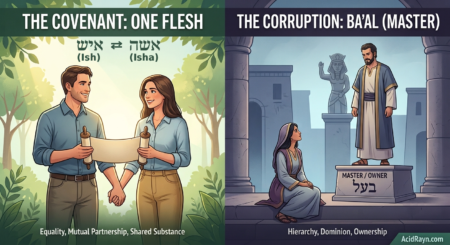
In the beginning, matrimony was never a hierarchy of master and possession. It was a covenant of shared substance. When YHWH brings the woman to the man in Genesis 2, the man’s response is not a claim of ownership — it’s a recognition of identity: “This is now bone of my bones, and flesh of my flesh; she shall be called Woman [אשׁה, ishshah], because she was taken out of Man [אישׁ, ish]” (Genesis 2:23). The two words are not separate categories of “owner” and “owned” — ishshah is the feminine form of ish. The text is built on a grammar of sameness, and it ends not with a transaction but with union: “they shall become one flesh” (Genesis 2:24). Scripture soon supplies the very word for how that union is enacted: יָדַע, yada, “to know.” “Adam knew [yada] Chawwah [Eve] his wife, and she conceived” (Genesis 4:1). Yada is not a euphemism reaching for a word the language lacked — it is the ordinary Hebrew term for knowing a person or a fact, applied here, without embarrassment, to the most intimate act two people share. The vocabulary makes no distinction between the physical and the personal way a modern reader might expect one; to know a spouse in this grammar is at once to be joined in body and disclosed in self, one word carrying both. That word will carry the same weight forward, later in Scripture, into how YHWH describes being known by His own people.

(Click Here to Continue Reading This Post)

Picking a Master is an Exercise in Slavery

As I scrolled through my Facebook news feed, I discovered the following artwork here, being shared by the page, “Made in Anarchy,” and originally posted it to my own wall, along with commentary…

“I don’t vote. Not because ‘it’s pointless,’ or ‘the system is rigged,’ or ‘I just don’t care,’ but because voting is quite literally the act of trying to select a master for my neighbors, and I don’t have that right. None of us do.”

My Commentary: “*Not JUST because…”
Picking a master is an exercise in slavery…

Begging Your Masters Will Get You Nowhere!

As I scrolled through my Facebook news feed, I discovered the following artwork here, being shared by the page, “An Anarchist Conversation,” and originally posted it to my own wall, along with commentary…

"I Begged"

“I Begged”

My Commentary: Good plan! *facepalm*

Discussing the Highly Historically-Inaccurate Portrayal of the Life of Slave Rebel, Nat Turner, in the Film, “The Birth of a Nation”

The following correspondence originally took place on my Facebook wall, upon my post, “‘The Birth of a Nation’ Presents a Highly Historically-Inaccurate Portrayal of the Life of Slave Rebel, Nat Turner”

"The Birth of a Nation"

“The Birth of a Nation”

Rayn: *sigh* What a waste of an opportunity… It figures…

“The Birth of a Nation” Is an Epic Fail:
https://www.thenation.com/article/the-birth-of-a-nation-is-an-epic-fail/

Tammy S.: I had such high hopes. Your cousins are going to see it today… I can’t wait to hear their opinion.

“The Birth of a Nation” Presents a Highly Historically-Inaccurate Portrayal of the Life of Slave Rebel, Nat Turner

I originally posted the following information and commentary onto my Facebook wall…

2016-10-07-the-birth-of-a-nation-presents-a-highly-historically-inaccurate-portrayal-of-the-life-of-slave-rebel-nat-turner

“The Birth of a Nation”

“The Birth of a Nation” Is an Epic Fail:
https://www.thenation.com/article/the-birth-of-a-nation-is-an-epic-fail/

(Leslie M. Alexanderfirestorm of controversy has swirled around Nate Parker and his film The Birth of a Nation in the two months since several media outlets revealed that Parker and his co-author, Jean McGianni Celestin, stood trial for raping a young woman in 1999. Across the country, social media lit up as people debated Parker’s guilt, questioned whether to boycott the film, and expressed outrage about violence against women. As the storm raged, however, one critical issue went ignored. No one questioned the fundamental value or quality of the film. Based on the standing ovations it received at the Sundance Film Festival, we assumed that The Birth of a Nation was inherently valuable, inspirational, educational, and transformative.

We were wrong.

The Birth of a Nation claims to tell the true story of Nat Turner, leader of the bloodiest slave rebellion in United States history. A film on Turner is long overdue, and as a professional historian of the black experience in the nineteenth century, I have anxiously awaited one. I was especially encouraged by September’s issue of Vanity Fair, in which Parker stated that he had become “obsessed with the idea of telling Nat Turner’s story” and that he sought to create “historical fidelity in his depiction of the leader of the rebellion.”

After attending an advance screening of the film, however, I now know that Parker failed miserably in his mission. Contrary to his promises of “historical fidelity,” Parker created a deeply flawed, historically inaccurate movie that exploits and distorts Nat Turner’s story and the history of slavery in America. Nearly everything in the movie—ranging from Turner’s relationship with his family, to his life as a slave, and even the rebellion itself—is a complete fabrication. Certainly the film contains sprinklings of historical fact, but the bulk of Parker’s story about the rebellion is fictitious: Nat Turner did not murder his owner, nor did he kill a slave patroller. Turner’s rebellion was not betrayed by a young boy, or by anyone else involved in the revolt.

(Read entire article here…)

My Commentary: *sigh* What a waste of an opportunity… It figures…