The following article was inspired by my post, “Curse of Adam“, with most scripture references sourced from Word-of-Yah.org using the The Scriptures 2009 (TS2009) translation.…
(Special thanks to my sister in Yeshua Mashiyach, Flora, for pointing out the root connection between ‘marriage’ and ‘ba’al’, among other considerations, and to my family at Kingdom of Heaven Assembly for many edifying discussions that helped shape this work.)

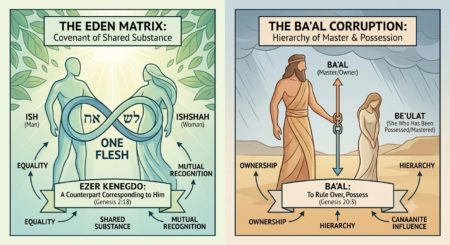
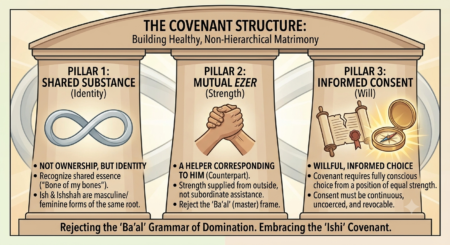
In the beginning, matrimony was never a hierarchy of master and possession. It was a covenant of shared substance. When YHWH brings the woman to the man in Genesis 2, the man’s response is not a claim of ownership — it’s a recognition of identity: “This is now bone of my bones, and flesh of my flesh; she shall be called Woman [אשׁה, ishshah], because she was taken out of Man [אישׁ, ish]” (Genesis 2:23). The two words are not separate categories of “owner” and “owned” — ishshah is the feminine form of ish. The text is built on a grammar of sameness, and it ends not with a transaction but with union: “they shall become one flesh” (Genesis 2:24). Scripture soon supplies the very word for how that union is enacted: יָדַע, yada, “to know.” “Adam knew [yada] Chawwah [Eve] his wife, and she conceived” (Genesis 4:1). Yada is not a euphemism reaching for a word the language lacked — it is the ordinary Hebrew term for knowing a person or a fact, applied here, without embarrassment, to the most intimate act two people share. The vocabulary makes no distinction between the physical and the personal way a modern reader might expect one; to know a spouse in this grammar is at once to be joined in body and disclosed in self, one word carrying both. That word will carry the same weight forward, later in Scripture, into how YHWH describes being known by His own people.
That is the matrimony YHWH designed from the beginning of creation. It is not the marriage that later teachings describe.
Ezer: The Word Translators Quietly Demoted
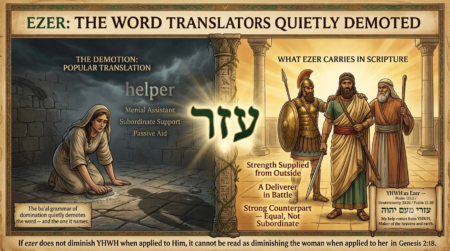
That grammar of sameness rests on one specific word choice for the woman herself — and it’s worth stopping on before tracing how a very different word later took its place. Before the woman is even formed, YHWH states His intent: “It is not good for the man to be alone, I am going to make a helper for him, as his counterpart” (Genesis 2:18). The Hebrew word translated “helper” is עזר, ezer — and in English, “helper” lands softly, almost menial, like an assistant or subordinate. That is not what the word carries in the rest of the text.
Ezer appears repeatedly in the Hebrew Bible describing YHWH Himself, in His relationship to Israel: “There is none like the El of Yeshurun, who rides the heavens to help you” (Deuteronomy 33:26); “My help comes from YHWH, Maker of the heavens and earth” (Psalm 121:2). YHWH is never once subordinate to the people He helps. The word describes strength supplied from outside, often a deliverer in battle — not an inferior assistant. If ezer doesn’t diminish YHWH when applied to Him, it cannot be read as diminishing the woman when applied to her. The text calls her ezer kenegdo — a helper corresponding to him, his counterpart, his equal — not a servant beneath him.
Even the rabbinic tradition — the same tradition this article will go on to trace into an architecture of ownership — preserves a countercurrent reading of ezer that lands closer to Genesis’s own sense than to eved. The Talmud records Rabbi Yosei putting the question to Elijah directly: “It is written: I will make him a helpmate. In what manner does a woman help a man?” Elijah’s answer reaches for partnership and contribution, not subordination: “When a man brings wheat from the field, does he chew raw wheat? When he brings home flax, does he wear unprocessed flax? His wife turns the raw products into bread and clothing. Is his wife not found to be the one who lights up his eyes and stands him on his feet?” (Yevamot 63a). Notably, this exchange sits on the same daf as Rashi’s more famous gloss on kenegdo — “if he is worthy she is a help to him; if he is not worthy she is against him” — the line most often reached for to cast ezer as conditional or adversarial. The tractate holds both readings side by side. Elijah’s own answer to the direct question of how a woman helps a man mentions no conditions, no worthiness test, no opposition — only a contribution the man could not supply for himself.
How “Ba’al” Got Smuggled In
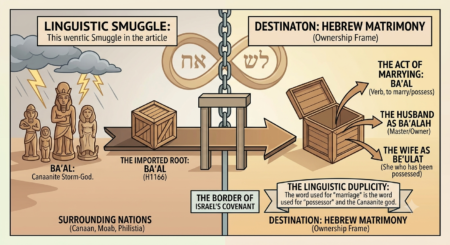
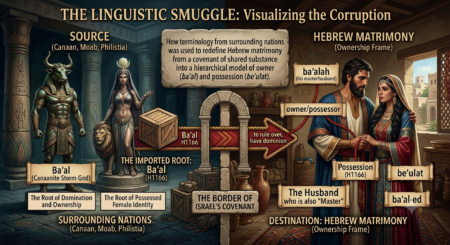
If ezer names what the woman was called at the beginning, ba’al names what she was renamed later — and the path that substitution took into the marriage vocabulary is the next thing worth tracing. Somewhere between Eden and later Hebrew usage, a different word starts attaching itself to “husband”: בַּעַל, ba’al — Strong’s H1166, a verb meaning to rule over, have dominion, or possess, and a noun meaning master, owner, lord. The first time the word appears in Torah, YHWH Himself uses it in a dream to warn Abimelech away from Sarah: “she is a בַּעַל, ba’al’s בְּעֻלַת, be’ulat” (Genesis 20:3) — rendered in the KJV as “a man’s wife,” but the underlying Hebrew is a ba’al (master/owner) and his be’ulat (she who has been possessed/ba’al-ed). The noun and the feminine passive participle of the same root appear together in the same verse — a man who is a ba’al owns a woman who has been ba’al-ed into that condition. The word beneath “wife” here is not ishshah — it is the passive form of the very root used for the storm-god of Canaan: she is not his covenant partner, she is his be’ulat, the one who has been mastered.
It is worth noting who YHWH is speaking to here: not an Israelite, but Abimelech, a Philistine king. YHWH meets him in the language and legal framework he would already understand — a woman as the be’ulat of a ba’al, property of an owner. That YHWH uses this language to communicate with a Philistine king rather than to prescribe the terms of covenant matrimony is itself telling: the ba’al framework is the language of the surrounding nations, the very framework Israel was repeatedly warned not to import. YHWH speaks it to Abimelech because it is Abimelech’s frame of reference — not because it is His own design for ish and ishshah.
When a man “marries” a woman in the underlying Hebrew, the verb being used is ba’al — he ba’als her. When she is called “his wife” or he is called “her husband,” the word beneath the English is often בַּעְלָהּ, ba’alah — her master, her ba’al. The KJV’s own translation choices reveal how deep this goes: Strong’s H1166 ba’al is rendered ‘marry’ eight times, ‘husband’ three times, ‘wife’ twice, and ‘dominion’ twice in the text — meaning the very word English Bibles use for the act of marrying a woman is, in the underlying Hebrew, the verb form of ba’al itself. The same root covers the husband who possesses his wife, the act of marrying, and Elohim’s own description of the broken covenant He intends to replace — and it is the very same word used for the storm-god of Canaan, whose worship Elohim spent centuries trying to root out of Israel.
An obvious objection deserves a direct answer here: words for “lord” or “master” often flatten into ordinary honorifics over time, shedding whatever active dominative force they once carried — an English speaker who called her husband “my lord” in earlier centuries wasn’t usually invoking literal feudal ownership. If ba’al underwent the same kind of semantic bleaching, its presence in the marriage vocabulary would prove nothing about the relationship’s actual structure. Two things push against that reading here. First, a fully bleached term doesn’t need correcting — Hosea’s argument in chapter 2 depends on ba’al still carrying enough active force, in his own generation, that YHWH names it and replaces it by name; a dead metaphor doesn’t require a prophet to un-name it. Second, and more importantly, the case made here was never resting on the word alone. The legal record — a bill of divorcement only the husband could issue, a wife who could be compelled to accept a divorce but not initiate one, a daughter transferred from father’s household to husband’s without her voice unless the text goes out of its way to record it — describes actively asymmetric ownership regardless of whether ba’al itself had gone semantically soft by any given century. Even a full concession on the word would leave the legal architecture it named fully intact.
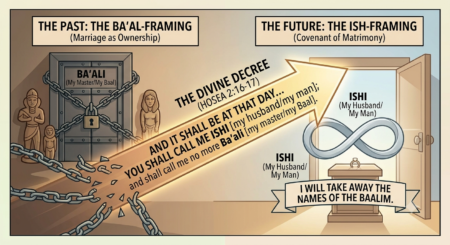
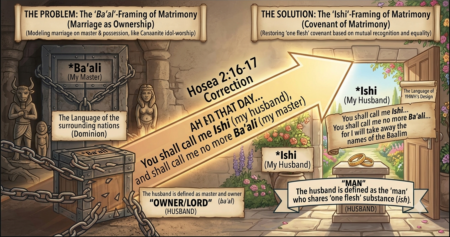
This is not a neutral linguistic coincidence. Hosea names it directly, as a thing YHWH intends to correct, not preserve:
“And it shall be at that day, says YHWH, that you shall call me Ishi [my husband/my man]; and shall call me no more Ba’ali [my master/my Baal]… for I will take away the names of the Baalim out of her mouth” (Hosea 2:16-17).
Notice what YHWH is rejecting here: not matrimony, but the ba’al-framing of “one flesh” matrimony into “marriage”— the idea that the relationship between husband and wife is a relationship of owner and property, modeled on the same grammar used for Canaanite idol-worship. Some teachers reverse this entirely — reading Hosea’s correction backward, as if ba’al-as-master were the ideal YHWH is restoring rather than the corruption He is removing. That reading requires ignoring the verse’s plain direction: away from ba’al, toward ish — and ignoring that the woman was named ezer, not eved (servant), from the start.
Ba’al: The Elohim of the Surrounding Nations
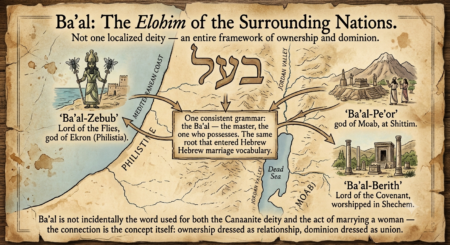
That substitution didn’t happen in isolation — ba’al was already doing identical work as the name of a god, across several of Israel’s neighbors, which is exactly why its presence in the marriage vocabulary is not incidental. Ba’al is not a word that belongs uniquely to Canaan — it is the religious and legal vocabulary of the surrounding nations broadly, which is precisely why YHWH spent centuries warning Israel not to import it. The text names its appearances explicitly across multiple peoples and places. Ba’al-Zebub — “lord of the flies” — is named as the god of Ekron, a Philistine city, when King Aḥazyah sends messengers to inquire of him rather than of YHWH: “Is it because there is no Elohim in Yisra’ĕl that you are going to inquire of Ba’al-Zeḇuḇ, the mighty one of Eqron?” (2 Kings 1:2-3). Ba’al-Pe’or was the god of Moab, and Israel’s worship of him at Shittim provoked one of YHWH’s most severe responses: “Yisra’ĕl dwelt in Shittim, and the people began to whore with the daughters of Mo’aḇ. They invited the people to the slaughterings of their mighty ones, and the people ate and bowed down to their mighty ones. Thus Yisra’ĕl was joined to Ba’al Pe’or” (Numbers 25:1-3). Ba’al-Berith — “lord of the covenant” — was worshipped in Sheḵem, and his temple treasury was used to fund Abimelech’s murderous seizure of power over Israel (Judges 9:4). The same root that means “master/owner/lord” in the marriage vocabulary thus also names the deity of a covenant — a lord of covenant, as opposed to YHWH whose covenant is direct and unmediated.
The word ba’al as “lord, master, owner” is broadly Semitic, not uniquely Canaanite — which is exactly why it could function as ordinary legal vocabulary for property and marriage relationships across multiple cultures in the ancient Near East simultaneously. A Philistine king, a Moabite cult, a Shechemite temple, and the underlying Hebrew word for “to marry” all share the same root because the concept itself — ownership, dominion, mastery over a person or territory — was the common cultural water of the surrounding nations. YHWH’s repeated warnings to Israel not to go after the Ba’alim were not warnings against one localized deity but against an entire framework of relating to the world: through ownership and dominion rather than through covenant and direct knowledge. That framework had many local names and faces — Ba’al-Zebub, Ba’al-Pe’or, Ba’al-Berith — but one consistent grammar underneath them all: the grammar of the ba’al, the master, the one who possesses. It is the same grammar that entered the Hebrew vocabulary for marriage, the same grammar YHWH names as the broken covenant in Jeremiah 31, and the same grammar He says He intends to remove from His people’s mouths entirely in Hosea 2. Ba’al is not incidentally the word used for both the Canaanite deity and the act of marrying a woman — the connection is the concept itself: ownership dressed as relationship, dominion dressed as union.
The Pharisaic Layer
That surrounding-nations vocabulary didn’t stay outside Israel’s own legal tradition for long — it eventually calcified into formal rabbinic law. This master-framing of matrimony didn’t stay confined to a word choice — it hardened into law and tradition under the rabbinic schools that shaped Second Temple Judaism. The Mishnah and later Talmud built an entire legal architecture around a woman as an asset transferred between men’s authority — from father’s household to husband’s — including rulings that explicitly excluded women from public Torah reading “out of respect for the congregation,” even while acknowledging women were technically eligible (Megillah 23a:11). That’s not a minor procedural footnote; it’s a tradition of men overriding what the text itself allowed, then presenting that override as authoritative law — the very pattern Yeshua confronted directly: “Why do you also transgress the commandment of Elohim because of your tradition?” (Matthew 15:3).
This is not a new failure mode — YHWH named it through Jeremiah centuries before the Mishnah was compiled: “How do you say, ‘We are wise, and the Torah of YHWH is with us’? But look, the false pen of the scribe has worked falsehood” (Jeremiah 8:8). The scribes claimed Torah while their pens worked against it — the same pattern the Pharisaic legal tradition repeated when it built an architecture of female ownership on top of a text that never prescribed it. The prophets had named this failure across centuries: priests doing violence to Torah and profaning what was set-apart (Ezekiel 22:26), prophets reckless and treacherous, priests profaning the set-apart place and doing violence to Torah (Zephaniah 3:4) — a pattern YHWH named long before the church inherited the same tendency.
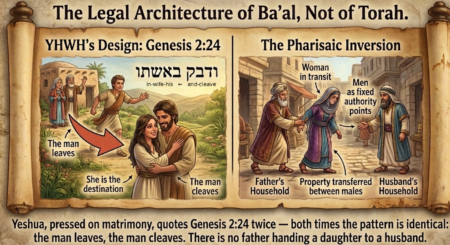
The transfer of a daughter from father’s household to husband’s household is the legal architecture of ba’al, not of Torah. It frames the woman as property in transit between two male authorities — never her own person, never a direct party to the covenant, always the object of the transaction rather than one of its subjects. But that framework runs directly against what the text of Genesis actually prescribes as the pattern for matrimony, and what Yeshua Himself reaffirms when asked about it. Genesis 2:24 does not describe a daughter moved from one household to another — it describes a son who leaves: “For this cause a man shall leave his father and mother, and cleave to his wife, and they shall become one flesh” (Genesis 2:24). The movement is the man’s. The cleaving is to the wife. The resulting union — one flesh — is the design. When Yeshua is questioned about matrimony, he does not reach for the Pharisaic legal tradition of daughters transferred between households — he quotes this verse directly and without revision: “Did you not read that He who made them at the beginning made them male and female, and said, ‘For this cause a man shall leave his father and mother and cleave to his wife, and the two shall become one flesh’?” (Matthew 19:4-5), and again in Mark: “For this cause a man shall leave his father and mother and cleave to his wife, and the two shall become one flesh. So that they are no longer two, but one flesh” (Mark 10:7-8). Yeshua quotes Genesis 2:24 twice in the gospel record on this subject, and both times the pattern is identical: the man leaves, the man cleaves, the two become one. There is no father handing a daughter to a husband. There is no transfer of female property between male households. There is a man departing his own origin point to be joined to his wife — a design in which she is the destination, not the object of exchange. The Pharisaic legal tradition inverted this entirely, placing the woman in transit and the men as the fixed points of authority on either end. Yeshua’s answer, when pressed on the question of matrimony, is to go back to Genesis 2 — not to the rabbinic architecture built on top of it, but to the text itself, where the one who moves is the man.
The Wife of Your Covenant
Before that legal architecture fully hardened, one prophet had already confronted the same drift directly, naming what a covenant matrimony actually requires of a husband. Centuries after Genesis, and centuries before the Mishnah hardened its own tradition, Malachi confronts the priesthood of his own day with a charge that runs away from mastery, not toward it. The immediate context is priestly corruption — “you have turned from the way, you have caused many to stumble in the Torah… you are showing partiality in the Torah” (Malachi 2:8-9) — the same failure Ezekiel and Zephaniah name elsewhere, priests doing violence to what is set-apart rather than guarding it. But Malachi’s rebuke doesn’t stop at the altar. It follows the men straight home, into their marriages, and the language he reaches for there is not the language of ba’al.
“Yet you ask, ‘Why?’ It is because YHWH has been witness between you and the wife of your youth, to whom you have been faithless, though she is your companion and your wife by covenant” (Malachi 2:14). The word rendered “companion” — chaverah — is not property vocabulary. It is a term of partnership, of one joined to another as an associate, the same root used elsewhere for fellow-workers and allies. YHWH does not call her the man’s possession here; He calls her his covenant partner, and He names Himself as witness to that covenant — standing not behind the husband as his authorizing power, but between husband and wife as the guarantor of what they owe each other directly. That is a strange thing for a “ba’al” marriage to require. Ownership does not need a witness to guard faithfulness; covenant does.
The chapter opens with the same shared-origin grammar Genesis 2 already established: “Have we not all one father? Has not one Ěl created us?” (Malachi 2:10) — echoing “bone of my bones, flesh of my flesh” almost word for word. And when Malachi turns to instruct the men directly, the command is not headship or rule — it is restraint: “guard yourselves in your spirit, and do not be faithless to the wife of your youth” (Malachi 2:15). The burden of the command falls on the husband, not the wife — the same pattern already visible in Ephesians 5’s call to self-sacrificing love and 1 Peter 3’s warning that a husband’s mistreatment of his wife hinders his own prayers. YHWH’s verdict on the alternative could not be more direct: “I hate divorce… and him who covers his garment with violence” (Malachi 2:16) — the language of “covering” appearing here, notably, as something YHWH condemns when it is wielded with cruelty, not something He commends as a husband’s rightful authority over his wife’s access to Him.
Read against ba’al, Malachi 2 supplies exactly what the ba’al framework cannot: a matrimony in which YHWH stands as direct witness to a covenant between two “companions,” not as the distant power behind a master’s claim to his be’ulat. Malachi’s language for a human marriage — companion, witness, covenant — is not borrowed from nowhere. It is the same covenant structure YHWH uses to describe His own relationship to Israel.
Pauline Christianity Inherited the Framework — and Dropped Ezer Along the Way
That same drift toward ba’al didn’t end with the Hebrew Scriptures — it resurfaces largely unexamined in how the apostolic writings describe marriage and church order. Rather than dismantling that inheritance, the early Hellenistic Christian movement absorbed much of it. Paul’s instruction that women “keep silent in the assemblies… for it is improper for women to speak” (1 Corinthians 14:34-35), and that a woman is not permitted “to teach or to have authority over a man” because “Adam was formed first, then Eve” (1 Timothy 2:11-15), reproduces the Pharisaic hierarchy almost verbatim — dressed in new theological language, but carrying the same assumption: that women’s standing before YHWH is mediated through male authority rather than direct.
Both of these texts carry more contested textual and interpretive history than a single citation suggests, and that history deserves acknowledgment rather than silence. 1 Corinthians 14:34-35 appears in a different location — after verse 40 — in several Western manuscript witnesses, a variant some scholars (Gordon Fee, Philip Payne) read as evidence the verses were a later marginal note absorbed into the text rather than part of Paul’s original argument. 1 Timothy 2:11-15 raises separate questions: many scholars regard the Pastoral Epistles as written by a later disciple in Paul’s name rather than by Paul himself, based on vocabulary distinct from the undisputed letters; and the verb translated “have authority over,” authentein, occurs nowhere else in the New Testament and in contemporary Koine usage leans toward “domineer” or “usurp authority” rather than ordinary teaching authority — which would make the instruction a correction of a specific abuse at Ephesus (compare 1 Timothy 1:3-7’s warning about false teachers there) rather than a universal rule. None of this settles the question outright. But engaging it honestly, rather than treating these verses as simply Paul’s plain and uncontested meaning, is the same interpretive charity a difficult text deserves regardless of which side of an argument it sits on.
Paul’s appeal to creation order here is doing exactly the same work that the ba’al substitution did centuries earlier: pointing to Genesis while skipping over what Genesis actually calls the woman, and over which Genesis account he’s even appealing to. Genesis 1 — the account of the perfected, completed creation — describes male and female in a single verse with no sequence at all: “And Elohim created the man in His image, in the image of Elohim He created him – male and female He created them” (Genesis 1:27). There is no “formed first” in that account; there is no temporal gap to build a hierarchy on. Ironically, Paul skips over Genesis 1, though it is first in order of appearance within Scripture, and leans on the later Genesis 2 narrative of creation. Yet even there, the second-formed party is described with the same word — ezer — used of YHWH’s relationship to Israel. If “formed first” established a hierarchy of dominance, Paul has no answer for Genesis 1’s single-verse account, where no such order exists, or for why the second-formed party in Genesis 2 carries the same word the text uses for YHWH Himself. The argument requires silence on both ezer and Genesis 1, not engagement with either.
The “formed first” argument does not survive its own logic applied consistently. If temporal priority in creation establishes rank, then Genesis 2 has already ranked the man beneath the trees — “YHWH Elohim planted a garden… and there He put the man whom He had formed” (Genesis 2:8) has the garden preceding Adam’s placement in it. It has ranked him beneath the animals too: before Eve is ever formed, YHWH forms every beast and bird and brings them to Adam first, precisely so that Adam can discover none of them will do — “but for Adam there was not found a helper corresponding to him” (Genesis 2:19-20). The animals are not formed after the man to serve him; on the Genesis 2 timeline itself, they are formed and paraded before him as candidates, and found wanting, before the woman ever appears. Genesis 1 repeats the pattern at larger scale: vegetation on the third day, sea and air creatures on the fifth, land animals earlier on the sixth than humankind that same day. If “formed first” is a coherent principle of authority, plants and sparrows outrank Adam, and cattle outrank the entire human race. Virtually no one reads it that way — which suggests the principle is not actually operating in the text. It is a conclusion in search of a text, not a text yielding a conclusion. Yeshua treats sequence and worth as entirely separate categories elsewhere in his own teaching: the birds of the air neither sow nor reap, and are fed regardless — yet “are you not of much more value than they?” (Matthew 6:26). Existing first, or existing at all in a given order, settles nothing about relative standing in Yeshua’s own reasoning. Paul’s argument requires readers not to notice that the same logic he applies to Eve applies, with equal force and Scripture’s own sequencing, to the sparrows.
That same Paul, however, when addressing matrimony directly rather than assembly order, writes something that cuts against the hierarchy his other letters assert: “the wife does not have authority over her own body, but the husband does. And likewise the husband does not have authority over his own body, but the wife does” (1 Corinthians 7:4) — a statement of mutual, reciprocal authority that has no master and no possession in it at all, and that sounds far closer to ezer kenegdo than to ba’al.
Ephesians 5 carries the same structure but complicates it from within. Paul instructs wives to “subject yourselves to your own husbands, as to the Master” and calls the husband “head of the wife” (Ephesians 5:22-23) — language that reads, on its surface, as a straight restatement of the ba’al hierarchy. But the verse immediately before it instructs the whole congregation, men included, to be “subjecting yourselves to one another in the fear of Elohim” (Ephesians 5:21), and the standard set for husbands isn’t dominion at all — they’re told to love their wives “as Messiah also did love the assembly, and gave Himself for it” (Ephesians 5:25), a model of self-sacrifice, not mastery. A husband instructed to give himself up for his wife is not functioning as her ba’al in the ownership sense — he’s been handed the harder job.
First Peter 3 runs the same tension. Wives are told to be “subject to your own husbands” (1 Peter 3:1), and husbands are told to dwell with their wives with understanding, “giving them respect as to a weaker vessel” (1 Peter 3:7) — language that has done real damage when read as license for condescension. But the same verse ends by naming the wife “joint heir of the grace of life,” explicitly so that the husband’s prayers aren’t hindered if he gets this wrong. The text makes the husband’s treatment of his wife a condition on his own standing before YHWH, not a grant of authority over her — closer to stewardship under accountability than to ownership.
The verse most often set against everything argued here is 1 Peter 3:5-6 itself, and it deserves to be named directly: Peter holds up “the set-apart women who trusted in Elohim,” who “were submissive to their own husbands,” citing “Sarah, who obeyed Abraham, calling him master” (1 Peter 3:5-6). Tracing that word itself confirms as much. The Greek κύριον, kyrion Peter uses here echoes the Septuagint’s rendering of Genesis 18:12, where Sarah, laughing at the promise of a son, says of Abraham ho kyrios mou — my master. The Hebrew source behind that LXX text is not the Tetragrammaton but the ordinary household honorific אֲדֹנִי, adoni — “and my master is old” — the same word used of any respected husband or master, never YHWH’s own name. The Delitzsch Hebrew New Testament (1877) confirms the same reading independently, rendering Peter’s own line as va-tikra lo adon — “and she called him adon.” When a New Testament kyrios can be traced through the Septuagint to a Hebrew original, the three texts either converge on YHWH or they don’t; here they converge cleanly on adon/adoni, not on the divine Name at all. Sarah’s address is ordinary marital courtesy, not the ba’al vocabulary this article has been tracing, and Peter’s citation carries no more theological weight than the word already carried in Genesis.
Read as a blanket endorsement of ba’al-as-ideal, this verse would undo the entire case made above. But the verse does not hold that weight. Peter’s own qualifier is fearlessness, not deference — the daughters of Sarah are defined by refusing terror, not by the address Sarah once used. And the record Peter is pointing back to does not show Abraham as the unqualified authority the word “master” implies: it is YHWH who tells Abraham, twice, to listen to Sarah’s voice against his own preference — “whatever Sarah says to you, listen to her voice” (Genesis 21:12), repeated already at Genesis 16:2. An authority regularly instructed by YHWH to submit his own judgment to his wife’s is not functioning as her ba’al — and Peter’s citation of Sarah’s address to him is no more a prescription of the ba’al framework than YHWH’s use of the same vocabulary with Abimelech in Genesis 20:3 was a description of His own design.
The same letter that tells wives to be submissive and calls them “the weaker vessel” also opens with a description that applies to every reader, unqualified by sex: “you are a chosen generation, a royal priesthood, a set-apart nation, a people for a possession” (1 Peter 2:9). Whatever “weaker vessel” is doing in chapter 3, it cannot be read as demoting women out of the priesthood chapter 2 has already granted them without distinction.
Read alongside ezer, these passages look less like an endorsement of the ba’al framework and more like apostolic writers working uneasily inside a culture still soaked in it — reaching for mutuality and self-sacrifice even while reusing the vocabulary of headship and subjection.
This assumption sits awkwardly next to the rest of the record. Miriam is called a prophetess by the text directly (Exodus 15:20). Deborah is likewise called a prophetess by the text directly, and judged Israel and directed a military commander who refused to act without her (Judges 4:4-9). Huldah, not any priest, was the one consulted to authenticate the rediscovered Torah scroll under King Josiah — and she too is called a prophetess by the text directly (2 Kings 22:14). Philip’s four daughters prophesied (Acts 21:9). Joel’s prophecy, repeated by Peter at Pentecost as being fulfilled in that moment, promises the Spirit poured out on “your sons and your daughters” and names daughters and female servants explicitly among those who “shall prophesy” (Joel 2:28-29, Acts 2:17-18). And it is women — not the male disciples — who are named as the first witnesses to the resurrection, and the text is more specific than is often noted: “Miryam from Maḡdala, and Yoḥanah, and Miryam the mother of Ya’aqoḇ, and the rest with them” (Luke 24:10) — at minimum three named women, plus others unnamed, who reported to the eleven that the tomb was empty and that they had seen a vision of messengers saying He was alive. Yeshua appeared first to Miryam from Maḡdala, who stood weeping at the tomb, and personally commissioned her — “Go to My brothers and say to them…” (John 20:11-18) — sending her as his messenger to the eleven before he had appeared to any of them. She received a word directly from the risen Yeshua, on his explicit instruction, and was sent to deliver it to named recipients. That is not a supporting role — that is a prophetic commission by the text’s own definition. She went and reported that He was alive, and they did not believe her (Mark 16:9-11). The full group of women reported next, and were likewise disbelieved — their words “appeared to them to be nonsense” (Luke 24:11). The pattern continues even after the tomb: later that same day, one of the two travelers on the road to Ammaʿus — Qleophas — describes the women to the stranger walking with them as “certain women of ours, who arrived at the tomb early, also astonished us” (Luke 24:22). “Women of ours” — not women whose report they had dismissed, not women of the fringe, but women counted among their own company, whose witness Qleophas himself rehearses to a stranger on the road. That a man would recount the women’s testimony while the women’s own testimony had been disbelieved is telling in itself: the witness passes through a male voice before it is taken seriously. When Yeshua himself appeared to the eleven, he did not commend their earlier caution — he reproached them directly: “He reproached their unbelief and hardness of heart, because they did not believe those who had seen Him after He was raised” (Mark 16:14). The word Mark uses here — hardness of heart — is not new to Israel’s story. It’s the same charge YHWH levels at the people themselves in the golden calf narrative: “I have seen this people, and see, it is a stiff-necked people” (Exodus 32:9), repeated again at Exodus 33:3, 33:5, and 34:9. Ezekiel later names the promised cure for that same condition: not a better law, but “a heart of flesh” replacing “the stony heart” (Ezekiel 11:19-20, 36:26-27). The disciples’ reflex to disbelieve the women closest to the empty tomb is the same stiff-necked reflex on display a second time — by the text’s own vocabulary, a live case of the very condition the renewed covenant exists to cure. The first witnesses to the resurrection were women — multiple named women, plus others. Yeshua personally commissioned one of them to carry the news to the eleven. The ones who refused to receive their testimony were the male disciples. And Yeshua rebuked the disbelievers, not the witnesses. A tradition that silences women and routes spiritual authority through men cannot appeal to Yeshua’s own practice here — the record runs the other way entirely.

Greek Law and Philosophy Built the Same Hierarchy From a Different Foundation
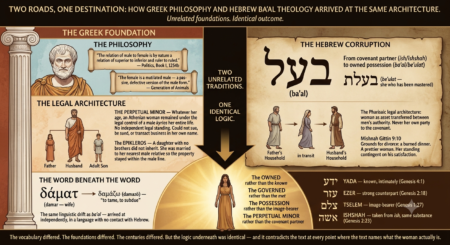
This pattern wasn’t unique to the Hebrew or Christian textual tradition. Working from an entirely separate intellectual foundation, Aristotle constructed nearly the same architecture through philosophy rather than legal tradition. In the Politics, Book I, 1254b, he wrote that the relation of male to female is “by nature a relation of superior to inferior and ruler to ruled.” In Generation of Animals, he defined the female as a “mutilated male” — a passive, defective version of the male form. This wasn’t abstract theorizing detached from consequence: classical Athens ran a state-regulated brothel system staffed by enslaved women with no legal standing, reportedly instituted as policy under Solon, and women were donated to temples by the hundreds as religious offerings according to ancient sources such as Athenaeus, discussed further here. Aristotle’s philosophy supplied the intellectual justification; Athenian law supplied the machinery; the brothel and the temple supplied the practice.
Two unrelated traditions — Hebrew legal and theological custom framing woman as possession under ba’al, Greek civil law and philosophy framing her as a perpetual legal minor and an ontologically deficient being — arrived at the same outcome through entirely different routes: women stripped of independent standing and subordinated to male authority by design. The vocabulary differed, the foundations differed, the centuries differed — but the logic underneath was identical: the woman as the owned rather than the known, the governed rather than the met, the possession rather than the image-bearer. Ba’al by another name, arrived at independently, and just as resistant to the text that contradicts it.
The legal architecture matched the philosophy. Every Athenian woman was, in the words of classicist John Gould, “a perpetual minor” — whatever her age, status, or social class, she remained for life under the legal control of a male kyrios, first her father, then her husband, then, if she was widowed, her own adult son, who alone could represent her in court, execute contracts of significant value, or act on her behalf; she had no independent legal standing to sue, be sued, or transact business in her own name (Gould, “Law, Custom and Myth,” Journal of Hellenic Studies 100 (1980); Women in Classical Athens – Wikipedia; Classics@ Journal, Harvard). A daughter with no brothers became an epikleros, an heiress in name only: rather than inheriting the estate herself, she was typically married off to her nearest male relative specifically so the property would stay within the male line (Women in Classical Athens). An old Greek term for wife, damar, comes from damazō — “to tame” or “to subdue,” the same root that gives Latin domare and English “tame” (Abarim Publications; Etymonline) — a linguistic parallel to ba’al‘s own drift from covenant partner to owned possession, arrived at independently, in a language with no contact with Hebrew.
This Touches the Ten Commandments, Too
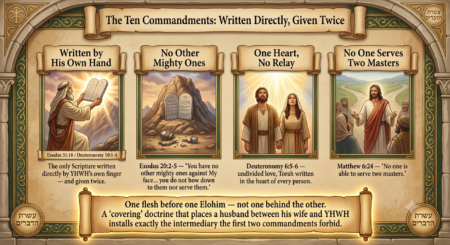
The stakes of this ba’al framework aren’t only historical — they collide directly with the one document in Scripture that carries YHWH’s own unmediated authority. Before turning to what the Ten Commandments say, it’s worth noting what they are structurally: the only portion of Scripture written directly by the finger of YHWH Himself, not relayed through a prophet’s hand or a scribe’s pen — and given not once but twice, after Moses broke the first tablets and YHWH wrote the second set Himself as well (Exodus 31:18; Deuteronomy 10:1-4). Every other book of Torah passes through a human hand holding the pen. This one does not, and YHWH did it twice rather than let the first breaking stand as the final word.
The “covering” doctrine that ba’al-as-master theology depends on — that a wife’s only access to YHWH runs through her husband, that he stands between her and her Maker — runs straight into the first two commandments of that same unmediated document. YHWH opens by naming Himself as the One who delivered His people out of slavery, then states the terms: “You have no other mighty ones against My face… you do not bow down to them nor serve them, for I, YHWH your Elohim am a jealous Ěl” (Exodus 20:2-5). A doctrine that places a husband between his wife and YHWH — making him the mediator she must go through rather than someone she stands beside before the same Elohim — installs exactly the kind of intermediary the first two commandments forbid, in the one document YHWH refused to let any human hand carry for Him. It does not matter whether the intermediary is carved from wood or made of flesh and married to her; an idol is anything set up to stand between a person and YHWH’s direct claim on them, and a “covering” doctrine constructs precisely that structure with a husband in the role.
The foundational command of Torah itself makes the same demand — “And you shall love YHWH your Elohim with all your heart, and with all your being, and with all your might. And these Words which I am commanding you today shall be in your heart” (Deuteronomy 6:5-6). A whole-hearted, undivided love of YHWH — commanded to every person, written in the heart of every person — leaves no structural room for a human mediator standing between that heart and the One it is commanded to love with everything. Torah’s own claim about itself confirms the directness of that reach: “The Torah of YHWH is perfect, converting the being” (Psalm 19:7) — not converting the husband who then relays the effect to his wife, but the being itself, directly, whoever it belongs to. A covering doctrine that routes a wife’s access to YHWH through her husband does not merely add a procedural step; it divides the very allegiance YHWH commanded to be whole, and interposes a relay where Torah claims to work on the soul unmediated.
Yeshua names the deeper structural problem directly: “No one is able to serve two masters, for either he shall hate the one and love the other, or else he shall cleave to the one and despise the other” (Matthew 6:24). This is not a word against matrimony — Genesis 2:24 calls a man to cleave to his wife, and that cleaving is YHWH’s own design. The point is that ultimate spiritual allegiance cannot be divided. Husband and wife are each called to stand directly before YHWH — not one behind the other, but both before the same Maker, one flesh before one Elohim. It is YHWH Himself who joins them — and Yeshua says so twice: “those whom Elohim has joined together, let man not separate” (Matthew 19:6), and again: “Therefore what Elohim has joined together, let man not separate” (Mark 10:9). The same pattern holds as with Genesis 2:24 — Yeshua quotes it once in Matthew, once in Mark, and both times the verdict is identical: Elohim joins, man does not separate. If it is Elohim who joins them, it is Elohim — not the husband — who stands at the centre of that union. A doctrine that places the husband between his wife and YHWH does not honour the union Elohim made; it inserts a human authority into the space Elohim Himself occupies, separating the wife from direct access to the One who joined her in the first place. What covering doctrine does is install the husband as a second spiritual authority in the space where YHWH’s direct claim on the wife should be uncontested — asking her, in effect, to serve two masters: her husband as mediator and YHWH as the distant one behind him. Ya’aqoḇ names what that produces: “he is a double-minded man, unstable in all his ways” (Ya’aqoḇ 1:8). A woman told simultaneously that YHWH writes His Torah directly on every heart and that her access to Him runs through her husband is not being asked for faithfulness — she is being asked to hold two incompatible orientations at once, and Ya’aqoḇ’s own measure of that condition is not devotion but instability.
Yeshua names this shift directly, using the same master-language, and resolving it the same direction Hosea already resolved ba’al: “No longer do I call you servants, for a servant does not know what his master is doing. But I have called you friends, for all teachings which I heard from My Father I have made known to you” (John 15:15). A servant’s access to his master’s business is whatever the master chooses to disclose, case by case. Yeshua names the alternative relationship in the same breath he offers it — nothing withheld, everything made known — and the term changes from doulos to philos to match. This is not servitude improved. It’s servitude traded for relationship, on the same terms Hosea already named for marriage.
Yoḥanan says the same thing even more directly: “But the anointing which you have received from Him stays in you, and you have no need that anyone should teach you. But as the same anointing does teach you concerning all, and is true, and is no falsehood, and even as it has taught you, you stay in Him” (1 John 2:27). If the anointing itself teaches every believer directly, a covering doctrine that makes a husband the necessary relay for his wife’s spiritual instruction is asking her to need what Scripture says she does not need.
This is also where the ba’al framing collides with how Scripture describes YHWH’s own character. He is repeatedly named as a Judge who shows no partiality and searches the heart directly — “For YHWH your Elohim is Elohim of mighty ones and Master of masters, the great Ěl, mighty and awesome, who does not show favoritism nor takes a bribe” (Deuteronomy 10:17), and “Peter opened his mouth and said, Truly I see that Elohim shows no partiality” (Acts 10:34)) — a claim Peter repeats at the Yerushalayim council with the mechanism named outright: “Elohim, who knows the heart, bore witness to them, by giving them the Set-apart Spirit, as also to us, and made no distinction between us and them, cleansing their hearts by belief” (Acts 15:8-9). Belief, not a mediating structure, is what Elohim names as the thing that cleanses and removes distinction. And “YHWH searches all hearts and understands all the intent of the thoughts” (1 Chronicles 28:9). His judgment carries the same perfection His character does — “He is the Rock, His work is perfect, for all His ways are right-ruling, an Ěl of trustworthiness and without unrighteousness, righteous and straight is He” (Deuteronomy 32:4). That judgment is also rendered to each person directly, by their own account, not by proxy through a household head: “I, YHWH, search the heart, I try the kidneys, and give every man according to his ways, according to the fruit of his deeds” (Jeremiah 17:10), and at the last judgment the pattern holds exactly the same shape — “the dead were judged… each one according to his works” (Revelation 20:12-13). A right-ruling that is perfect, without unrighteousness, and rendered to each individually has no need of a second, lesser standard for one class of people it judges — favoritism is not an oversight a perfect Judge might commit by accident, it is a contradiction of the perfection itself. YHWH had already named the standard when He rejected Israel’s first king for a second — Saul, chosen partly for his stature (“taller than any of the people,” 1 Samuel 9:2), gives way to David, chosen by a different measure entirely: “man looks at the eyes, but YHWH looks at the heart” (1 Samuel 16:7). One Torah and one standard applies to every person without exception — “One law is for you of the assembly and for the stranger who sojourns with you… As you are, so is the stranger before YHWH. One Torah and one right-ruling is for you and for the stranger who sojourns with you” (Numbers 15:15-16). If Torah applies identically regardless of birth status, the same principle leaves no room for a second tier of standing before YHWH based on gender within marriage.
YHWH is a Judge who searches every heart directly, shows no partiality, and administers one Torah for all has no theological need for a male intermediary to relay a woman’s heart to Him, or to stand as the channel through which she is known or judged. “Covering” doctrine quietly contradicts the very character of the Elohim it claims to honor.
This is also where the priesthood question matters. Peter had already said the same thing decades earlier, addressed to ordinary believers rather than a vision of the throne room: “you are a chosen generation, a royal priesthood, a set-apart nation, a people for a possession” (1 Peter 2:9) — no qualifier of sex attached to who counts as priesthood. Revelation describes the same reality in its own vision: those redeemed by Yeshua are “a reign, priests to his Elohim and Father” (Revelation 1:6), and again, “You have made us, to our Elohim, sovereigns and priests, and we shall reign over the earth” (Revelation 5:10). Every believer, male and female alike, is made priest — with the charge that comes with it. Ya’aqoḇ defines what that priesthood looks like in practice: “Clean and undefiled religion before Elohim and the Father is this: to look after orphans and widows in their distress” (Ya’aqoḇ [James] 1:27), and warns that “mercy boasts over judgment” (Ya’aqoḇ 2:13). A priesthood charged with caring for the poor, the widow, and the orphan has no room in it for one believer mediating another believer’s standing before YHWH on the basis of gender. A husband cannot simultaneously be his wife’s fellow-priest, charged with mercy toward the vulnerable, and her ba’al standing between her and direct access to the One they’re both meant to serve. The two roles are not compatible — and Scripture assigns every believer the first one, not the second.
When Yeshua drove the money-changers from the Temple, he named the precise failure — and he did so in all four gospel accounts (Matthew 21:12-14, Mark 11:15-18, Luke 19:45-46, John 2:13-16): “My House shall be called a house of prayer for all nations, but you have made it a den of robbers.” The prophecy he is quoting is Isaiah 56, where YHWH declares that His house is for all peoples — explicitly including those whom tradition had excluded: “to them I shall give in My house and within My walls a place and a name better than that of sons and daughters” (Isaiah 56:5), and “My house is called a house of prayer for all the peoples” (Isaiah 56:7). YHWH had already warned what happened when His house became a gatekeeper’s institution — through Jeremiah He named it directly: “Do not trust in these false words, saying, ‘This is the Hĕḵal [Temple] of YHWH, the Hĕḵal of YHWH, the Hĕḵal of YHWH!'” (Jeremiah 7:4) — invoking YHWH’s name over a house that had become a system of exclusion and transaction rather than direct access. A house meant for all nations, converted into a transactional system run by gatekeepers, is the same structural failure at stake when a covenant meant for direct relationship between every believer and YHWH gets converted into a hierarchy where a wife’s access runs through her husband instead — YHWH’s name kept on the structure, while the direct access He designed is quietly replaced by a system of mediation He never prescribed.
Yeshua’s confrontation with the Pharisees over commandments nullified by tradition applies here with full force: “Why do you also transgress the command of Elohim because of your tradition?… So you have nullified the command of Elohim by your tradition” (Matthew 15:3-6). “Covering” theology functions as exactly that kind of tradition — scriptural-sounding vocabulary built on top of, and in contradiction to, the commandments it claims to be honoring.
Yeshua himself reached for this precedent directly when accused of blasphemy for calling himself Son of Elohim. Rather than deny the charge, he points to Psalm 82: “Is it not written in your Torah, ‘I said, you are elohim’? If He called them elohim, to whom the word of Elohim came — and the Scripture cannot be broken…” (John 10:34-35), citing “I said, you are elohim, and all of you are sons of the Most High” (Psalm 82:6). Yeshua’s own argument does not hinge on office or status — it hinges on one thing only: that the word of Elohim came to them. That is the same ground the renewed covenant’s design already stakes out — Torah written directly on the heart, “from the least of them to the greatest of them” (Jeremiah 31:34), with no qualifier of gender attached to who receives it. If the word of Elohim reaching a person is, by Yeshua’s own reasoning, sufficient ground for the designation “elohim,” it is more than sufficient ground for a wife to stand directly before her Maker without a husband positioned as the one through whom that word must first arrive.
This is the renewed covenant Jeremiah describes — and even there, the language is instructive. YHWH says of the old, broken covenant: “My covenant which they broke, though I was a husband to them, declares YHWH” (Jeremiah 31:31-32). The word translated “husband” there is not ish — it is בָּעַלְתִּי, ba’alti, the first-person past tense of ba’al itself: “though I ba’aled them.” YHWH is not describing the ideal covenant relationship He designed in Genesis 2 — He is describing the old covenant in the language of the very framework He says He intends to remove. The broken covenant was ba’al. The renewed covenant that replaces it moves, by Hosea’s own terms, away from ba’al and toward ish — toward direct, unmediated knowledge written on the heart rather than rule enforced from outside. Jeremiah 31 and Hosea 2 are reading the same direction: the ba’al framework belongs to what was broken, not to what is being restored. The renewed covenant He promises in its place is not one of external rule enforced from outside, but Torah written directly on the heart — and this is not a new destination but a return to one. YHWH had already commanded it at Sinai itself: “And you shall love YHWH your Elohim with all your heart, and with all your being, and with all your might. And these Words which I am commanding you today shall be in your heart” (Deuteronomy 6:5-6). The heart was always the intended address — the ba’al framework diverted it. The renewed covenant restores what was commanded from the beginning: “But this is the covenant I shall make with the house of Yisra’ĕl after those days, declares YHWH: I shall put My Torah in their inward parts, and write it on their hearts” (Jeremiah 31:33) — the same verb, and the same hand, that once wrote on stone twice rather than let a human scribe carry the first covenant. What YHWH refused to relay through Moses’ pen at Sinai, He now writes Himself a second time, on a different surface entirely — not tablets a husband could stand beside and interpret for his wife, but the heart itself, “from the least of them to the greatest of them” (Jeremiah 31:34), with no need for one person to mediate YHWH’s knowledge to another: “no longer shall they teach, each one his neighbour… for they shall all know [יָדַע, yada] Me”. It is the same yada that once named the union of husband and wife (Genesis 4:1) — knowing that is at once physical and personal, undivided — not rule enforced from outside, but that same undivided knowing, restored as the address every heart was always meant to receive.
A Curse Is Not a Command
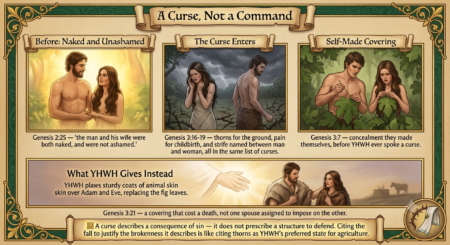
Given how directly ba’al theology cuts against that unmediated design, its defenders usually fall back on a single verse to justify it — and that verse deserves its own scrutiny. Genesis 3:16 — where YHWH tells the woman her husband “rules over” her — is the verse most often pressed into service to settle the matter for good. Men of faith cite it from pulpits and across the internet as if it settles the question, as if dominance were the created design rather than its breakdown. But read in context, the verse sits inside a list of curses, not a list of commands. The ground is cursed to bring forth thorns. Childbirth is cursed with pain. And the relationship between man and woman is named as broken, marked now by a struggle for control that wasn’t there in Genesis 2’s “one flesh,” ish-and-ishshah, ezer kenegdo design. A curse describes a consequence of sin entering the world — it does not prescribe a structure to defend or perpetuate. Citing the fall to justify the very brokenness it describes is like citing thorns and pain in childbirth as YHWH’s preferred state for agriculture and motherhood.
The same chapter that records the curse also records what preceded it: “the man and his wife were both naked, and were not ashamed” (Genesis 2:25) — a transparency with nothing to hide, no fig leaves, no distance. That state ends the moment they sin: “the eyes of both were opened… and they sewed fig leaves together, and made themselves coverings” (Genesis 3:7). Their first instinct after the rupture is self-made covering — concealment they construct themselves, before YHWH ever speaks a curse. When YHWH does provide covering, it is not the fig leaves they made but “coats of skin” He makes for them (Genesis 3:21) — a covering that costs a death, foreshadowing the pattern this article traces to its end. The “covering doctrine” this article has been dismantling borrows the word from this chapter but inverts its meaning: in Genesis 3, covering is what shame produces and what YHWH alone remedies at cost to Himself — not a structure one spouse is assigned to impose on the other.
Scripture itself tells His people what to do with corruption introduced by sin: return, don’t entrench. “Stand in the ways and see, and ask for the old paths, where the good way is, and walk in it, and find rest for yourselves” (Jeremiah 6:16). The old path here is not Genesis 3’s curse — it’s Genesis 1 and 2’s design, before the fall introduced the very rule-and-strife dynamic the curse describes. YHWH’s own remedy for the fall is not to formalize its damage but to reverse it at the root: “I shall give them one heart, and put a new spirit within you. And I shall take the stony heart out of their flesh, and give them a heart of flesh” (Ezekiel 11:19-20; see also Ezekiel 36:26-27). A new heart undoes the fall’s corruptions; it doesn’t codify them as permanent law.
Yeshua’s own teaching on marriage points the same direction, but the verse deserves a closer look than it usually gets: “For in the resurrection they neither marry nor are given in marriage, but are as messengers of Elohim in heaven” (Matthew 22:30). The Greek’s active and passive pairing — “marry” and “are given in marriage” — echoes the same legal transaction Torah itself names: a man “takes” a wife, a woman is “given” (cf. Exodus 34:16; Deuteronomy 7:3) — the same root, נָשָׂא, nasa, active and passive, a pairing the Delitzsch Hebrew New Testament (1877) renders in the same terms independently: lo yis’u nashim, lo tinnasenah. That is contract language, the vocabulary of the very ba’al machinery this article has traced — not Genesis 2’s one-flesh knowing. And the dispute provoking the answer was itself a legal one: the Sadducees frame a case of levirate marriage, the provision requiring a brother to marry his dead brother’s childless widow so a name and inheritance would not be erased by death (Luke 20:27-33; Deuteronomy 25:5-6). Luke’s fuller record supplies the hinge the whole answer turns on: those raised “cannot die anymore, for they are like the messengers, and they are sons of Elohim, being sons of the resurrection” (Luke 20:36) — “sons of Elohim” here echoing the heavenly-court sense of the phrase in Job (1:6, 2:1, 38:7), not the Psalm 82 sense already discussed above, where “sons of the Most High” names every believer’s direct standing. Marriage as a legal institution answers to death — it perpetuates a name, secures an inheritance, replaces what dying removes. Where death has no more purchase, that legal apparatus has nothing left to accomplish — not because Eden’s one-flesh design was never real, but because the legal machinery built on top of it was invented, centuries later, to manage a mortality that will no longer exist.
If Genesis 3:16 names the damage rather than the design, the historical record shows exactly how that damage was administered — not as a diagnosis anyone kept treating as a wound, but as a license men wrote into law. It shows up first at the threshold of matrimony, in how a woman’s own voice was, or was not, asked for.
Not Given in Matrimony: What Consent Looked Like Before Ba’al Corrupted It
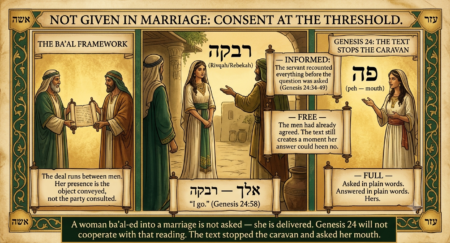
Genesis 24 is, on its surface, the most patriarchal-looking marriage arrangement in Torah. Abraham sends his servant to find a wife for Isaac. The servant negotiates entirely with Rebekah’s father and brother. Gifts are given, an oath is invoked, the match is agreed to by every male party involved before Rebekah has said a single word (Genesis 24:50-53). By every external marker, the deal is already closed. And then the text does something it did not have to do. The next morning, when the family wants her to stay ten more days before leaving, the servant presses to depart immediately — and instead of the men simply deciding the matter between themselves a second time, the text records: “We will call the young woman and ask at her mouth” (Genesis 24:57). The Hebrew is פה, peh — mouth — the same organ Scripture uses everywhere else for a person’s own direct speech, not a proxy’s. They call her. They ask her directly: “Do you go with this man?” And her answer is recorded in her own voice, first person, unmediated by father or brother: “I go” (Genesis 24:58).
Every condition of a genuine consent is present in that one verse, and none of them were narratively necessary if the text only cared about ownership. The consent is informed — by this point in the chapter the servant has already recounted the entire oath, the sign he prayed for, and YHWH’s evident hand in the match to the whole household, out loud, before the question is ever put to her (Genesis 24:34-49); she is not agreeing to a stranger she knows nothing about. The consent is free — the men had already reached an agreement without her, the caravan was ready to leave, and the text still creates a moment where her answer could, structurally, have been no. And the consent is full — it is not implied by her silence, not assumed from her family’s agreement, not read off her presence at the table. It is asked in plain words and answered in plain words, hers.
This is the same grammar Genesis 2 already established: ezer kenegdo, a counterpart whose voice counts, not property whose disposition is decided over her head. It is also the same grammar the ba’al framework has no place for. A woman ba’al-ed into a marriage is not asked; she is delivered. Her peh is never queried because her peh was never the point — the transaction runs between men, and her presence is the object being conveyed, not a party being consulted. That is precisely the architecture behind most attempts, ancient or current, to defend child marriage or coerced marriage as righteous by appeal to “the family agreed” or “she wants it” while stripping away everything that would make that want mean anything — independent standing, real information, a genuine ability to say I do not go. It is the golden calf trick again, run on a smaller and more intimate stage: keep the vocabulary of consent, keep even the girl’s own words if convenient, while removing every structural condition that would make those words her own rather than a script handed to her. Genesis 24 will not cooperate with that reading. The text had every opportunity to skip Rebekah’s answer and simply proceed on her family’s word — and it chose, instead, to stop the caravan and ask her mouth.
If consent belonged at the threshold of matrimony, its corruption ought to be traceable at the other end as well — not just in how a woman entered a marriage, but in how she could be removed from one. That is exactly where the legal record becomes most explicit, and most damning.
The Bill of Divorcement: Ba’al’s Legal Machinery
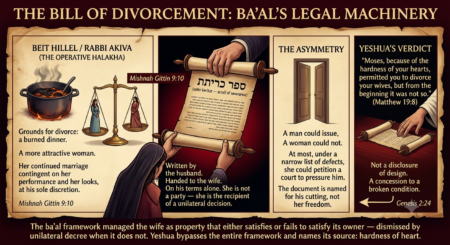
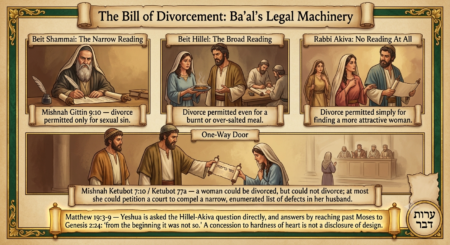
Deuteronomy 24:1 permits a man to write his wife a bill of divorcement if he finds in her “some matter of indecency” — the Hebrew ערות דבר, ervat davar — but Torah never defines the phrase, and it is exactly that undefined space the later legal tradition filled in with ba’al’s logic rather than YHWH’s. The Mishnah preserves the dispute directly. Beit Shammai read the phrase narrowly, restricting it to sexual sin: “A man may not divorce his wife unless he finds out about her having engaged in a matter of forbidden sexual intercourse [devar erva], i.e., she committed adultery or is suspected of doing so, as it is stated: ‘Because he has found some unseemly matter [ervat davar] in her, and he writes her a scroll of severance'” (Mishnah Gittin 9:10). Beit Hillel read it broadly enough to include a wife who merely burned or over-salted her husband’s dinner: “He may divorce her even due to a minor issue, e.g., because she burned or over-salted his dish, as it is stated: ‘Because he has found some unseemly matter in her,’ meaning that he found any type of shortcoming in her.” Rabbi Akiva went further still, ruling a man could divorce his wife simply for finding a woman he found more attractive: “He may divorce her even if he found another woman who is better looking than her and wishes to marry her, as it is stated in that verse: ‘And it comes to pass, if she finds no favor in his eyes'” (Mishnah Gittin 9:10). The halakha followed Hillel and Akiva, not Shammai — meaning the operative Jewish law of the Second Temple period made a woman’s continued marriage contingent on her cooking and her looks, at her husband’s sole discretion, with no comparable exit available to her.
The asymmetry runs deeper than the grounds for divorce — it runs through who could even initiate the proceeding. The Mishnah is explicit that a woman could be compelled to accept a divorce but could not issue one herself; at most, under a narrow list of enumerated defects in the husband, she could petition a court to pressure him into granting one: “And these are the defects for which the court forces him to divorce her: One afflicted with boils; or one who has a polyp; or one who works as a gatherer, or one who works as a melder of copper, or one who works as a tanner of hides, all of whose work involves handling foul-smelling materials” (Mishnah Ketubot 7:10). The Gemara’s later discussion of what actually counts as grounds for that kind of compulsion — refusal of support, refusal of conjugal relations — makes clear how narrow and conditional even that recourse was: “Rav stated: If a husband says, ‘I will neither maintain nor support [my wife]’, he must divorce her and also give her the kethubah. Rabbi Elazar went and mentioned this teaching in front of Samuel [who] exclaimed, ‘Make Elazar eat barley; rather than compel him to divorce her let him be compelled to support her'” (Ketubot 77a). The document itself carries the asymmetry in its name — a sefer keritut, a scroll of cutting off, written by the husband, handed to the wife, on his terms alone. The architecture matches everything already traced from ba’al: the woman evaluated as property that either satisfies or fails to satisfy its owner, dismissed by unilateral decree when it does not — never her own party to the covenant’s dissolution any more than she was, under the Pharisaic layer, her own party to its formation.
The same tractate that sets the terms for a woman’s exit from marriage sets the terms for her labor inside it, and the two lists rhyme. Mishnah Ketubot 5:5 itemizes a wife’s contractual obligations to her husband with the same specificity later used against her at the point of divorce: “she grinds wheat into flour, and bakes, and washes clothes, cooks, and nurses her child, makes her husband’s bed, and makes thread from wool by spinning it” (Mishnah Ketubot 5:5). The mishnah does not stop at the list — it prices it, scaling her labor obligations down as her dowry-wealth scales up, measured in enslaved women: one maidservant relieves her of grinding, baking, and washing; two, of cooking and nursing; three, of bedmaking and spinning; four, and she “may sit in a chair like a queen and not do anything, as her maidservants do all of her work for her.” A wife’s labor is not incidental detail here — it is the very unit the mishnah weighs against her dowry, tradable line by line for property, on a scale denominated in other women’s bondage. The same legal mind that catalogs a wife’s household output down to the spindle is the one that later catalogs, with equal precision, the grounds on which her husband may discard her.
This is the exact dispute Yeshua is dropped into when the Pharisees test him: “Is it right for a man to divorce his wife for any reason?” (Matthew 19:3) — the Hillel-Akiva position, phrased almost verbatim. Yeshua does not adjudicate between the schools, he bypasses the entire framework: “Moses, because of the hardness of your hearts, permitted you to divorce your wives, but from the beginning it was not so” (Matthew 19:8). That sentence does two things at once. It concedes the law existed — Torah does permit a certificate of divorce. And it names the permission as a concession to a broken condition, not a disclosure of design, in the same breath he reaches back past Moses to Genesis 2:24’s one-flesh union as the actual standard.
Yeshua does not stop at diagnosis — he narrows the concession itself: “whoever divorces his wife, except for sexual immorality, and marries another, commits adultery” (Matthew 19:9). That single exception — πορνεία, porneia, sexual immorality — collapses Hillel and Akiva’s entire ruling and lands, of the three rabbinic positions on record, closest to Shammai’s: the narrowest reading of ervat davar, not the broadest one. Yeshua is not simply saying divorce grieves him, he is siding, on the actual legal question the Pharisees asked him, against the halakha that had won — against the burnt dinner and the prettier face as grounds for putting a woman out — and reasserting something closer to the original narrow reading of the very phrase Deuteronomy left undefined. The move is identical to the argument about Genesis 3:16: a text that describes a concession to hardness is not the same thing as a text that prescribes the hardness as ideal. The “hardness of heart” Moses accommodated and the ba’al framework are the same hardness — a heart no longer capable of the direct, undivided knowing Eden had, managed by external legal machinery instead of healed at the root.
Lust as Adultery is Not a New Dimension: Guarding the Tenth Commandment
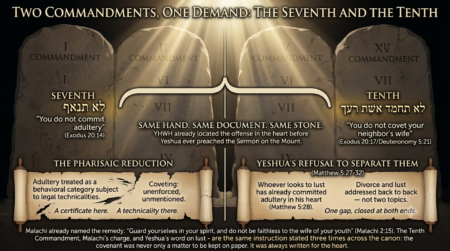
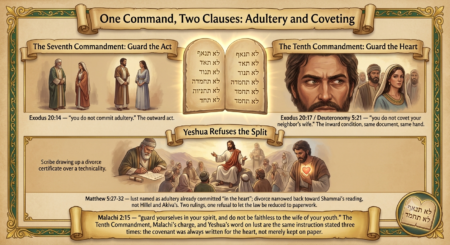
Yeshua’s ruling on divorce doesn’t stand alone in that sermon — a few verses earlier he makes the identical move against the same legal minimalism the divorce debate exposed. It is usually read as an escalation — a new inward standard layered on top of an old outward one: “whoever looks at a woman to lust after her has already committed adultery with her in his heart” (Matthew 5:28). But the seventh commandment was never the only relevant commandment on this subject, and it was never only external. The Ten Commandments — the one document YHWH wrote directly, twice — already close with a command aimed at nothing but the internal state: “you do not covet your neighbor’s wife” (Exodus 20:17; Deuteronomy 5:21). Coveting is not an act performed on someone’s body. It is a condition of the heart toward someone else’s spouse, named as a violation in the same document, by the same hand, alongside “you do not commit adultery.” Torah had already located the offense in the heart before Yeshua ever preached the Sermon on the Mount. He is not adding a dimension the Ten Commandments lacked — he is refusing to let the seventh commandment be read in isolation from the tenth, the way the Pharisaic and Hillel-Akiva tradition had effectively done by treating “adultery” as a strictly behavioral category subject to legal loopholes (a certificate here, a technicality there) while leaving coveting unenforced and unmentioned. Read together, the seventh and tenth commandments were always one demand in two clauses: guard the act, and guard the wanting that precedes it. Yeshua’s “you have heard it said… but I say to you” formula throughout Matthew 5 is consistently this same move — not overriding Torah, but refusing the truncated version of Torah the tradition had settled for.
This is also why the divorce ruling and the lust teaching sit back-to-back in the same sermon and are not two separate topics (Matthew 5:27-32). A legal culture that had reduced “some matter of indecency” to a burnt dinner had, by the same motion, reduced marital fidelity to whatever a man could get past a scribe — a standard of the hands and the paperwork, not the heart. Yeshua closes both ends of that gap in the same breath: divorce is not the design, hardness of heart is not license, coveting was never outside the Commandment’s reach, and even his narrow exception for porneia draws the line tighter than the halakha of his own day was willing to draw it. Malachi had already named the remedy for the husband’s side of this specifically: “guard yourselves in your spirit, and do not be faithless to the wife of your youth” (Malachi 2:15) — guard the spirit, not merely the hand holding the certificate. The Tenth Commandment, Malachi’s charge to guard the spirit, and Yeshua’s word on lust are the same instruction stated three times across the canon: the covenant was never only a matter to be kept on paper. It was always written for the heart — exactly where the renewed covenant of Jeremiah 31 relocates it, and exactly where ba’al’s legal machinery, from the Mishnah’s grounds for divorce to the Pharisees’ loopholes, could never reach.
The First Liar Was Not the Serpent
Tracing ba’al‘s legal architecture back through Yeshua’s corrections raises an earlier question — where this pattern of control first entered the human story at all, and Scripture’s answer starts before the serpent ever speaks. The accusing spirit’s first words on the pages of Scripture belong to the naḥash [serpent] — and its first target, on the surface of the text, is not Eve but YHWH Himself. Before a single piece of fruit is touched, the serpent opens with a misquote: “Is it true that Elohim has said, ‘Do not eat of every tree of the garden’?” (Genesis 3:1). That is not what YHWH said. The serpent’s opening move reframes a single restriction as total prohibition — making YHWH sound maximally withholding before the conversation has even begun. It is an accusation dressed as a question, and it draws Eve into correcting him with what she believes to be YHWH’s own command. What she exposes in correcting it, however, is that the command she’s holding is not the command YHWH gave — a second, more restrictive clause has been welded onto it: “Do not eat of it, nor touch it, lest you die” (Genesis 3:2-3).
But ask the question the text never quite forces you to ask: who gave Eve the commandment? She wasn’t there to receive it. “And YHWH Elohim commanded the man, saying, ‘You do eat of every tree of the garden, but of the tree of the knowledge of good and evil, you do not eat of it, for in the day that you eat of it you shall certainly die'” (Genesis 2:16-17) — spoken to Adam alone, second-person singular, before the woman is even formed. She has no direct line to this command. The only way it reaches her is through him. And by the time it reaches her, it isn’t the same command. “We are to eat” — plural now, held jointly by a married pair rather than issued to one man — and expanded, with “nor touch it” welded on where YHWH said only “do not eat” (Genesis 2:16-17). Genesis doesn’t narrate the moment of transmission, so this can’t be proven outright — the shape of the evidence is suggestive rather than conclusive: singular command in, plural and expanded command out, with Adam the most plausible relay.
The classical rabbinic reading in fact runs the other direction: Genesis Rabbah 19:3 holds that Eve herself added the “nor touch” restriction on top of YHWH’s actual words to Adam — “the Holy One blessed be He said merely, ‘as on the day that you eat of it,’ but she did not say that, rather she added on to it.” In that account, it’s precisely the added restriction that gives the serpent his opening: he pushes her against the tree to show her she doesn’t die from touching it, then argues from that disproven addition to the real command itself. That reading is worth naming rather than passing over, because it shows the ambiguity cuts both ways — the text simply does not say who added the clause. What the text does say, without ambiguity, is that Adam alone received the command and Eve received it only through him. That fact carries the weight of this section even where the more specific claim about who altered it cannot.
Scripture never treats speech as neutral. “Death and life are in the power of the tongue, and those who love it shall eat its fruit” (Proverbs 18:21) — and the pattern behind that claim goes back to the very first chapter: YHWH doesn’t build the world with His hands, He speaks it into being. “And Elohim said, Let there be light, and there was light” (Genesis 1:3), the same formula repeated across every day of creation — He speaks, and it is. A word from YHWH’s mouth is not a suggestion. It’s a creative act. Which means a false word spoken with His authority behind it isn’t a harmless embellishment either — it’s the same mechanism, aimed the other direction. If speech is the tool YHWH used to bring the garden into existence, it’s also the tool that can corrupt what stands in it, and Adam is the first person in Scripture to use it that way.
That makes Adam something the text never names outright but the pattern demands be named: the first human prophet, and the first false one, in the same breath. A prophet, at the most basic level Scripture uses the word, is someone who carries YHWH’s word to another who has no access to it except through him — which is exactly Adam’s position toward Eve. He is her only source. And he corrupts the source before he delivers it, handing her something stamped with YHWH’s authority that YHWH never said. Isaiah names this exact office and its exact cost, centuries later, in words that could have been written for Eden: “the prophet that teaches lies, he is the tail” — and the next verse names what it costs the one who trusts him: “the leaders of this people cause them to err, and they that are led of them are destroyed” (Isaiah 9:15-16). Eve is led. Eve is destroyed by the leading — not by the serpent’s word first, but by the false word she was handed before the serpent ever opened his mouth. The serpent doesn’t originate the lie that ruins her. He finds one already standing, finds the seam where it’s already weak, and puts his full weight exactly there. That is not authorship. That is exploitation of material already prepared for him. The first liar in this story is not the naḥash — it’s Adam. The serpent is only ever the second one.
And that first lie is the hinge the whole fall swings on. Read against the fence Adam built, “you shall certainly not die” (Genesis 3:4) isn’t a clean lie from the serpent at all — Eve is holding proof, at that moment, that it’s false. She has touched the fruit. Nothing happened. The serpent isn’t contradicting YHWH; he’s confirming what she already knows from experience, while quietly exposing the lie she’d been told. It’s only against the real command — “do not eat,” not the added “do not touch” — that verse 4 becomes the false denial it’s usually read as. The serpent tells a precisely targeted half-truth in order to exploit a lie that was already load-bearing. Nothing in 3:4-5 is false in every clause — “your eyes shall be opened, and you shall be like Elohim, knowing good and evil” turns out to be true enough that YHWH says nearly the same thing Himself three verses later (Genesis 3:22). What makes it the lie John names — “he was a murderer from the beginning… he is a liar, and the father of it” (John 8:44) — isn’t only what the serpent said. It’s what he left out. Nothing about shame. Nothing about hiding from the voice that once walked with them in the cool of the day. Nothing about exile, or the sword that guards the way back. Everything offered, true. The cost, withheld.
The bill comes due immediately. Before: “the man and his wife were both naked, and were not ashamed” (Genesis 2:25). After: “the eyes of both were opened… and they sewed fig leaves together, and made themselves coverings” (Genesis 3:7). Shame. Concealment. Self-made covering, before YHWH has spoken a single word of curse — the price “your eyes shall be opened” never mentioned. Yeshua names the same reflex centuries later, as a general pattern rather than a one-time event: “everyone who is practising evil hates the light and does not come to the light, lest his works should be exposed” (John 3:20). Adam and Eve’s hiding among the trees is the first instance of exactly what Yeshua describes — not fear of YHWH abstractly, but the specific instinct to stay unseen once there’s something to hide.
Notice, too, what the naḥash never does. He never touches them. He has no hand to strike with, no authority to curse until YHWH curses him, no power to force a single outcome. His entire arsenal, start to finish, is a sentence — the same tool YHWH used to make the garden, and the same tool Adam had already misused to corrupt a command inside it. Every act of actual damage in the chapter — the eating, the sewing of coverings, the hiding among the trees — is done by Adam and Eve’s own hands, to themselves. This was never a hostile takeover. It was an inside job, and the serpent’s only contribution was knowing exactly where to knock.
Which means the fall does not begin with the serpent’s lie. It begins with Adam’s — a false word laid over YHWH’s true one — and the serpent’s lie works on Eve so efficiently precisely because Adam’s had already broken first. A command sufficient on its own gets reinforced by a man who didn’t trust it to hold, and that reinforcement is the first thing tested and the first thing to fail. The serpent doesn’t have to defeat YHWH’s word. He only has to defeat Adam’s fence, and let the fence’s collapse drag the real word down with it. YHWH had already named this kind of addition as a breach in its own right: “Do not add to the Word which I command you” (Deuteronomy 4:2); “Do not add to His Words, lest He reprove you, and you be found a liar” (Proverbs 30:6). The pattern the Pharisees would later formalize into an entire legal architecture — binding heavy burdens beyond what the text commands (Matthew 23:4), nullifying the word of Elohim through tradition (Mark 7:13) — appears here first, at the smallest possible scale, in one husband’s addition to one command. Yeshua’s contrast could hardly be sharper: “my yoke is easy and my burden is light” (Matthew 11:30) — the opposite of a fence that crumbles before it protects.
The break between Adam and Eve comes next, and it runs the same pattern downward — the accusing spirit that first moved upward against YHWH now moves through the man. In Genesis 2, Adam’s first recorded speech is union: “This is now bone of my bones and flesh of my flesh” (Genesis 2:23). In Genesis 3, confronted with his own choice, his words become distance and blame: “The woman whom You gave to be with me, she gave me of the tree and I ate” (Genesis 3:12) — disowning her as “the woman” rather than the flesh of his own flesh, and in the same breath redirecting the accusation upward, toward YHWH, for having given her to him at all. Eve, asked the same question, does neither. She doesn’t disown Adam and she doesn’t accuse YHWH — she simply names the one who actually deceived her: “The naḥash deceived me, and I ate” (Genesis 3:13). Hers is a true statement about a real deception. His is a disowning wrapped around an accusation. The covenant doesn’t break symmetrically — it breaks in Adam’s mouth, from a man who has already added one false word to YHWH’s command and now adds a second, aimed at YHWH Himself and at the wife he’d called his own bones only one chapter earlier.
Yeshua names exactly where defilement actually originates: “not that which goes into the mouth defiles the man, but that which comes out of the mouth, this defiles the man” (Matthew 15:11) — and more pointedly still, “by your words you shall be declared right, and by your words you shall be declared unrighteous” (Matthew 12:36-37). Eden’s defilement is usually read as a matter of the mouth that ate — Eve’s. But by Yeshua’s own measure, the more telling mouth in this scene is Adam’s, and Genesis gives us both of his statements to compare. The first, spoken the moment he sees her, is creative and unifying — the same kind of speech YHWH used to make the world: “This is now bone of my bones and flesh of my flesh” (Genesis 2:23). The second, spoken the moment he’s confronted, is defiling in exactly the sense Yeshua means it — not what he ate, but what came out of him after: “The woman whom You gave to be with me, she gave me of the tree and I ate” (Genesis 3:12). Two sentences from the same mouth. One builds a union out of nothing, echoing his Maker. The other tears it back down. A union does not need both parties turning to fracture — one is enough, and Yeshua’s own diagnosis names what a house turned against itself becomes: “every kingdom divided against itself is laid waste, and every city or house divided against itself shall not stand” (Matthew 12:25; Mark 3:25). The one-flesh covenant breaks here, in Adam’s own mouth, before any curse is pronounced — self-inflicted, not handed down, and his division, not a mutual one.
The same disowning posture resurfaces a generation later, in different words: Cain, asked where his brother is, answers, “I do not know. Am I my brother’s guard?” (Genesis 4:9). The disowning words follow the first murder in Scripture — Cain has already killed Abel before he speaks them. When confronted with relational responsibility, the fallen instinct is to disown the bond rather than answer for it.
The same accusing posture resurfaces, at larger scale, in something more organized — a killing decided as necessary for the people as a whole. It is Qayapha, the high priest that year, who pronounces it: “it is better for us that one man die for the people than that the entire nation should perish” (John 11:50). The office meant to carry YHWH’s word most directly becomes the office that sentences His messenger to death, and John notes the bitter irony: “he did not say this from himself, but being high priest that year he prophesied” (John 11:51) — a false prophet’s office speaking truer than it knew, while meaning something else entirely. The same accusing spirit that moved from disowning to murder in Cain’s case escalates here from private murder to capital murder dressed as necessity.
This accusing posture has a name and an end point. Revelation calls it directly: “the accuser of our brothers has been thrown down, who accused them before our Elohim day and night” (Revelation 12:10). The spirit that adds to the word, disowns relationship, and shifts blame — Adam’s addition passed off as YHWH’s own, the serpent’s half-truth, Adam’s “the woman whom You gave me,” Cain’s “Am I my brother’s guard,” Qayapha’s “one man must die for the nation” — is, by Revelation’s own naming, the accusing spirit itself. It does not get a permanent place in the new creation. It is thrown down, not enthroned.
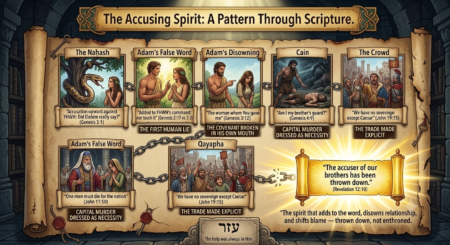
Trading Direct Covenant for Ruling Master
The same trade Adam makes in Eden — direct relationship exchanged for something more manageable — repeats at national scale throughout Israel’s history, this time between the whole nation and YHWH Himself. The trade of direct covenant for a ruling master is not unique to marriage — it’s a pattern YHWH names explicitly elsewhere in Israel’s history. When the elders of Yisra’ĕl demand a sovereign to “rule us like all the nations” (1 Samuel 8:5), and the people confirm it — “then we shall be, we also, like all the nations, and our sovereign shall rule us and go out before us and fight our battles” (1 Samuel 8:20) — Samuel warns them what that sovereign will do: “he shall take your sons and appoint them for himself, for his chariots and for his horsemen, and they shall run before his chariots. And he appoints for himself captains over his thousands and captains over his fifties… and your daughters… and you shall be his servants” (1 Samuel 8:11-17). Sons given by covenant relationship to YHWH become, under a human master, instruments of his war machine — commanders, captains, soldiers, conscripted into violence that serves the king’s purposes rather than YHWH’s. This is the same escalation from private to sanctioned violence traced earlier from Cain to the cross, now made structural: a king doesn’t just commit violence himself, he organizes a whole nation’s sons into the apparatus that carries it out at scale, with the language of order and command standing in for the direct relationship YHWH offered instead. YHWH’s own verdict on the request is direct: “they have not rejected you, but they have rejected Me from reigning over them” (1 Samuel 8:7). The prophets carry that verdict forward into its long consequence — YHWH Himself names the outcome centuries later through Hosea: “You have destroyed yourself, O Yisra’ĕl, but your help is in Me. Where is your sovereign now to save you in all your cities, and your rulers of whom you said, ‘Give me a sovereign and rulers’? I gave you a sovereign in My displeasure, but I took him away in My wrath” (Hosea 13:9-11). The trade Israel demanded in Samuel’s day didn’t deliver what they sought — YHWH names the sovereign they chose as His displeasure, not His provision, and the taking away of that sovereign as His wrath, not His abandonment. The help was always in Him; the sovereign was what they got instead. The word YHWH uses here for “help” is עֶזֶר, ezer (Hosea 13:9) — the same word used of the woman in Genesis 2:18, the word this article began by recovering. Israel traded their ezer for a sovereign, and YHWH names the trade for what it was: self-destruction. The pattern runs in both directions — from marriage to nationhood, from the garden to the throne room — and the word underneath it is always the same: ezer, the strength that comes from direct relationship, displaced by the master that dominates instead.
That Israel was owed ezer at all, rather than mere rule, is not incidental — it’s the whole relationship. Israel does not stand to YHWH as subject to sovereign. Israel stands to YHWH as bride to husband, and every later use of ezer draws on a covenant already cut in those terms. “You have seen what I did to the Mitsrites, and how I bore you on eagles’ wings and brought you to Myself” (Exodus 19:4), YHWH says just before Sinai — and what follows at Sinai is not a treaty between ruler and ruled but a covenant, sealed in the same structure a marriage is sealed. Jeremiah remembers it in exactly those terms, generations later: “I remember you, the loving-commitment of your youth, the love of your bridehood, when you went after Me in the wilderness” (Jeremiah 2:2). Ezekiel makes the covering language explicit, and ties it directly to the pattern traced from Eden forward: “I spread My skirt over you and covered your nakedness. And I swore an oath to you and entered into a covenant with you, and you became Mine” (Ezekiel 16:8) — a covering that is not self-made, like Adam and Eve’s fig leaves, but given, like the coats of skin YHWH made them afterward, like the bridal garment Revelation describes at the end. This is why ezer was ever Israel’s to lose. A subject has no claim on a sovereign’s help — a sovereign rules, and a subject obeys. A bride has every claim on her husband’s help, by the terms of the covenant itself. Israel asking for a king in 1 Samuel 8 was not simply asking for the wrong form of government. It was asking to be treated as a subject rather than a wife — trading a covenant that owed her ezer for one that only owed her rule.
The same trade appears again at Sinai, in a different moment. While Moses is on the mountain receiving the Torah directly from YHWH’s own voice, the people grow impatient with a relationship they cannot see or touch, and ask Aaron for something they can: “Arise, make us mighty ones who go before us” (Exodus 32:1). What they build is a golden calf, and what they say of it is telling: “This is your mighty one, O Yisra’ĕl, that brought you out of the land of Mitsrayim” (Exodus 32:4). Aaron then builds an altar before it and makes the substitution explicit: “Tomorrow is a festival to YHWH” (Exodus 32:5). They don’t reject YHWH’s name — they keep the label and replace the substance, trading the costly, unmediated, voice-from-the-mountain relationship He’d actually offered for a manageable image they could see, control, and schedule a festival around. That’s the offer idolatry always makes: not “leave YHWH,” but “keep His name on something you can manage instead of something that asks everything of you.” The same impulse runs through every generation that has chosen chariots over covenant: “Some trust in chariots, and some in horses, but we remember the Name of YHWH our Elohim” (Psalm 20:7) — and “Woe to those who go down to Mitsrayim for help, and rely on horses, who trust in chariots because they are many, and in horsemen because they are very strong, but who do not look to the Set-apart One of Yisra’ĕl, nor seek YHWH!” (Isaiah 31:1). The chariots and horsemen Isaiah names are the same apparatus Samuel warned the king would conscript Israel’s sons into — what begins as a demand for a visible, manageable sovereign ends as a nation trusting in the very war machine that sovereign built, and looking to neither for the help that was always only YHWH’s to give. It’s the same trade that happens on a more personal and intimate scale inside marriage when ba’al replaces ish: a direct, covenantal relationship for a tangible ruling master, with the same warned outcome: being taken, owned, governed, rather than known. YHWH had already named the alternative centuries earlier, through Zechariah: “Not by might nor by power, but by My Ruach” (Zechariah 4:6) — strength that comes from presence, not from chariots, thrones, or armies assembled to make a relationship visible and controllable.
The trade reaches its most explicit institutional form before the cross, in the council chamber where the chief priests and Pharisees gather specifically because Yeshua’s signs are too visible to ignore: “What shall we do? Because this Man does many signs. If we let Him alone like this, they all shall believe in Him, and the Romans shall come and take away from us both our place and nation” (John 11:47-48). The thing being protected is named plainly — not YHWH’s covenant, not Torah, not the people’s relationship with their Maker, but their place and their arrangement with Rome. The direct work of YHWH happening in front of them is weighed against institutional survival under a foreign ruling master, and the institution wins. It is Qayapha, the high priest, who closes the calculation: “it is better for us that one man die for the people than that the entire nation should perish” (John 11:50). The office designed to stand closest to YHWH’s direct voice becomes the office that sentences His messenger to death in order to preserve the people’s arrangement with Caesar — the same trade Israel made at Sinai and in Samuel’s day, now made by the highest religious authority in the land, in explicit service of Roman power.
The same trade reaches its climax at the cross, where every voice raised against Yeshua converges on the same renunciation Samuel and Sinai warned against. When Pilate first brings Yeshua out, it is the chief priests and officers who cry “Impale! Impale!” (John 19:6); soon after, the Yehuḏim press Pilate with a political threat — release Him and you are no friend of Caesar’s (John 19:12). Then Pilate presents Yeshua one final time — “See your Sovereign!” (John 19:14) — and the crowd shouts back, “Away, away, impale Him!” When Pilate asks directly whether he should impale their Sovereign, it is the chief priests who answer for them all: “We have no sovereign except Caesar!” (John 19:15). Three groups, one trade — officers, the Yehuḏim, and the chief priests in turn, each disowning the direct, covenantal Sovereign standing in front of them for the ultimate ruling master, the same exchange demanded at Sinai and asked for in Samuel’s day, now spoken aloud at the foot of the cross. But the trade turns on them immediately. Pilate fastens a title to the stake — “YESHUA OF NATSARETH, THE SOVEREIGN OF THE YEHUḎIM” (John 19:19) — and when the chief priests object, asking him to qualify it as merely a claim, he refuses: “What I have written, I have written” (John 19:22). Having traded covenant for master, that master’s own apparatus is what nails the truth of the rejected reign over their heads, in writing, for everyone to read — the same exchange, at national scale, that ba’al makes of matrimony: a direct relationship surrendered for a ruling master, in exchange for being taken, owned, governed, rather than known.
The same trade continues, even three decades after Yeshua’s crucifixion. Paul, being a Pharisee by training, of the tribe of Binyamin (Philippians 3:5), and a murderer by his own past — consenting to the stoning of Stephanos, ravaging the assembly, dragging off men and women to be locked up (Acts 8:1-3), still breathing out threats and murder against the taught ones of the Master when he set out for Damascus (Acts 9:1) — was also a Roman citizen by birth (Acts 22:28), steeped in every layer of the controlling tradition this article has traced: Pharisaic legal architecture, Roman imperial authority, and a personal history of violence carried out under cover of zeal for the law. When false charges were brought against him by the same chief-priestly office that had once demanded Yeshua’s death, Paul appealed not to YHWH’s direct judgment but to Caesar’s judgment seat: “I appeal to Caesar” (Acts 25:11). The same man who once stood among the accusers later sought the same Roman seat of authority the crowd at Golgotha had chosen over their own Sovereign — proof that the pattern, once learned, runs deep, and that even those most fluent in the architecture of control are not automatically free of it by conversion alone.
Against all of this — the king demanded, the golden calf erected, the high priest’s calculation, the crowd’s renunciation — Scripture sets a different measure entirely. “It is better to take refuge in YHWH than to trust in man. It is better to take refuge in YHWH than to trust in princes” (Psalm 118:8-9). The nations that surrounded Israel, the princes and rulers chosen over YHWH’s direct reign, are weighed by a different scale than the one they imagine themselves on: “See, nations are as a drop in a bucket, and are reckoned as dust on the balance” (Isaiah 40:15), and “All nations before Him are as a non-entity, and they are reckoned by Him as less than a speck, and emptiness” (Isaiah 40:17). The one before whom every nation is a drop and a speck is the same one Israel traded for a king, the same one the crowd traded for Caesar, the same one a wife is told to access through a husband rather than directly — and Isaiah names what happens to the rulers chosen in His place: “It is He who sits above the circle of the earth, and its inhabitants are like grasshoppers… who brings princes to naught, shall make the rulers of the earth as emptiness” (Isaiah 40:21-23). Every ruling master chosen over direct covenant with YHWH is, by Isaiah’s measure, emptiness substituted for the One who makes emptiness of empires. The trade is never equal — and it never was.
The Torah names this repair before Ezekiel or Jeremiah do, and gives it its own term: circumcision of the heart. “And you shall circumcise the foreskin of your heart, and harden your neck no more” (Deuteronomy 10:16); “YHWH your Elohim shall circumcise your heart… to love YHWH your Elohim with all your heart” (Deuteronomy 30:6). The mark this promises is not external — not a boundary marker on the body that certifies status to other people — but an internal removal of exactly the hardness that later makes the disciples dismiss the women’s report, discussed above. A covenant that circumcises the heart rather than the flesh has no more use for a husband certifying his wife’s standing than for a priest certifying a foreigner’s — Ezekiel says as much when he bars “the uncircumcised in heart” from the set-apart place regardless of physical circumcision (Ezekiel 44:9). The mediating structure ba’al depends on is precisely what a circumcised heart no longer needs.
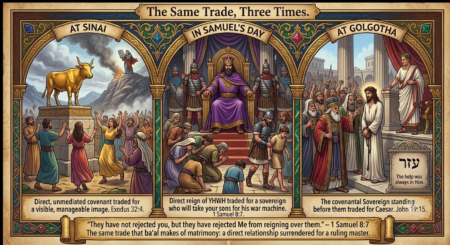
The Bridegroom, Not the Ba’al
Against every one of those trades, Scripture holds up a single alternative picture of what a covenant relationship with YHWH was always meant to look like. If Genesis 3:16 names the breakdown rather than the blueprint, Scripture doesn’t leave the reader guessing what the repair looks like — Hosea already named it, in the same word this article opened with: not mastery, but knowing. Hosea’s rejection of ba’ali does not leave an empty space where the word “master” used to sit. In the same breath, YHWH names what replaces it: “I shall betroth you to Me forever… in righteousness and in right-ruling, and in kindness, and in compassion… in faithfulness, and you shall know [יָדַע, yada] YHWH” (Hosea 2:19-20). Betrothal, not ownership. Yada — the same intimate, unmediated knowing Adam and Eve had in Genesis 2, before ba’al entered the vocabulary — not being ruled. The prophet who names YHWH’s rejection of ba’al in one verse names His self-description as a bridegroom in the next.
Isaiah reaches for the same picture and adds the missing note of delight: “as a bridegroom rejoices over his bride, so your Elohim rejoices over you” (Isaiah 62:5). A ba’al does not rejoice over his possession. A bridegroom rejoices over his bride.
Centuries before either prophet reached for this language, Israel’s own wisdom literature had already put mutual desire at the center of matrimony, with no trace of ba’al anywhere in it. The Song’s refrain is reciprocal, not owned: “I am my beloved’s, and my beloved is mine” (Song of Songs 2:16; repeated at 6:3) — the same structure Paul reaches for in 1 Corinthians 7:4, centuries later. The woman in the Song is no passive object of pursuit; she searches the city for him on her own initiative (3:1-4), and when her own brothers propose to manage her value like property — “if she is a wall… if she is a door” — she answers for herself, in her own voice, overriding their transaction with her own claim: “I am a wall… I was in his eyes as one who finds peace” (8:10). And the Song names directly what ba’al’s transactional logic amounts to: “Love is as strong as death… it cannot be quenched, nor drowned. If a man were to give all the wealth of his house for love, it would be utterly scorned” (8:6-7). Ba’al is a framework of transaction and ownership. The Song’s own verdict on that framework, inside the matrimony material itself, is contempt.
Yeshua takes up this same self-description directly. When questioned about fasting, he identifies himself as the bridegroom whose presence is cause for celebration, not austerity (Matthew 9:14-15). Yoḥanan the Immerser, told that people are following Yeshua instead of him, answers with the same image, and names his own place in it without envy — the same friendship Yeshua had already offered the disciples in place of servanthood: “He who has the bride is the bridegroom, but the friend of the bridegroom, who stands and hears him, rejoices greatly because of the bridegroom’s voice” (John 3:29). Yeshua’s own parables carry the picture forward — a sovereign making “a wedding feast for his son” (Matthew 22:1-14), and ten virgins waiting on the bridegroom’s return (Matthew 25:1-13).
The picture does not stay a parable. It closes the story. Revelation announces, at the consummation of all things, that “the marriage of the Lamb has come, and his wife has prepared herself” (Revelation 19:7-9), and describes the restored Yerushalayim itself descending “prepared as a bride adorned for her husband” (Revelation 21:2), with a messenger offering to show “the bride, the Lamb’s wife” (Revelation 21:9-10). The word behind “husband” here is not ba’al — it is the ordinary Greek word for husband, anēr, the same root the New Testament uses for man generally, with none of the ownership freight Hebrew’s ba’al carries. Scripture’s last word on marriage is not a master claiming property. It is a bridegroom whose whole posture toward his bride is joy, self-giving, and presence — the same design named in a garden at the very beginning, now spoken as the ending too. The picture closes exactly where Genesis 3:21 opened it: a covering not self-made but given. Fig leaves are traded for coats of skin at a death; here the bride’s own garment is described the same way — provided, not sewn together in shame (Revelation 19:8).
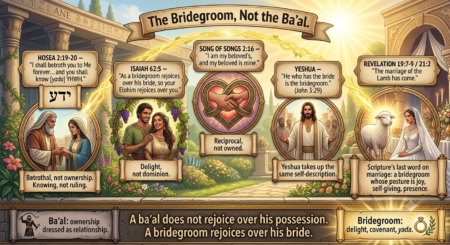
What This Means
That picture, and the many independent counterfeits set against it throughout this article, point toward a conclusion worth stating plainly. The “ba’al” theology — woman as property, mastered rather than in matrimony, silent rather than prophesying, covered by a man rather than standing directly before her Maker — is not the matrimony of Genesis 2. It is the marriage of a later corruption, built first in Adam’s own corruption of YHWH’s word in the garden, exploited by the accusing spirit rather than originated by it, hardened into Pharisaic legal tradition, paralleled independently in Greek philosophical tradition, and then carried forward, largely unexamined, into the church through Pauline instruction. None of this requires a unifying conspiracy to be damning — it’s arguably worse that it doesn’t. When the same architecture of control turns up independently across unrelated civilizations and centuries, in Adam’s own addition to a sufficient command, in his disowning words that followed it, in the Mishnah’s transfer of women between men’s households, in Aristotle’s “mutilated male,” and in the crowd’s “we have no sovereign except Caesar” — it points to something more durable and more ordinary than a hidden plot: the same default human tendency toward controlling what was meant to be trusted, disowning what was meant to be held close, and trading direct relationship for manageable control, surfacing wherever it finds an opening.
YHWH named the correction before any of these traditions had fully formed. Through Hosea He said it plainly: “At that day, declares YHWH, you shall call Me Ishi [my husband, my man], and shall call Me no more Ba’ali [my master, my Baal]… for I shall take away the names of the Ba’als out of her mouth” (Hosea 2:16-17). The direction is not toward ba’al as the corrected and purified form of matrimony — it is away from ba’al entirely, back toward ish, back toward the grammar of sameness the text established in Genesis 2 before Adam added his first fence, before the serpent ever needed to speak a first misquote, before the fall introduced the very rule-and-strife dynamic that later traditions codified as design. The renewed covenant Jeremiah describes moves in the same direction — Torah written on the heart as it was always commanded to be (Deuteronomy 6:6), direct and unmediated, extended to ‘the least of them to the greatest of them’ with no qualifier of gender (Jeremiah 31:33-34). A covenant that direct has no structural need for a husband standing between his wife and YHWH — and a matrimony built on that covenant has no need for ba’al.
Restoring ish and ishshah — one flesh, shared origin, ezer kenegdo, mutual authority before the same Maker — isn’t a modern innovation. YHWH already named where it was always meant to land: not ba’ali, but ishi. Not my master, but my man.
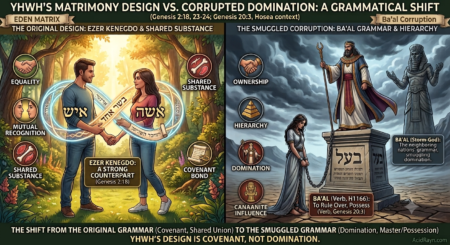
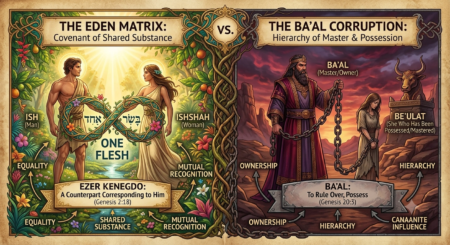
[Editor’s Note: First published June 30, 2026, at roughly 1,400 words (a 7-minute read), and expanded over the following three days to its current length, roughly 18,000 words (an 80 minute read). The author did not set out to write an article of this length or scope. What began as a short reflection grew, over three days and more than 40 hours of inspiration, research and writing, into the fuller work above — with the author led by her love of YHWH to pursue the Truth and Wisdom of His Word into a depth of Torah she had not anticipated.]
*Bonus Conceptual Art*

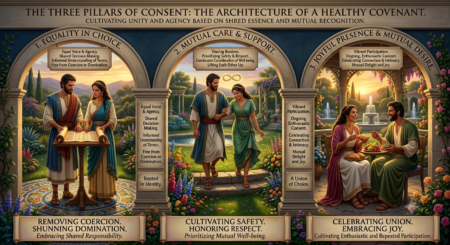
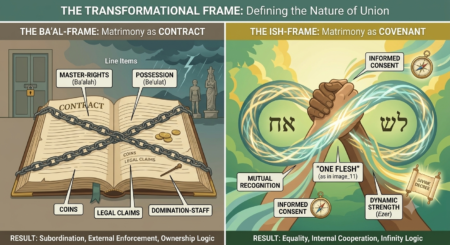
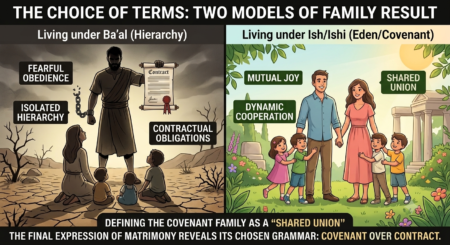
*Alternative Article Infographics*