I originally posted the following information onto my Facebook wall…
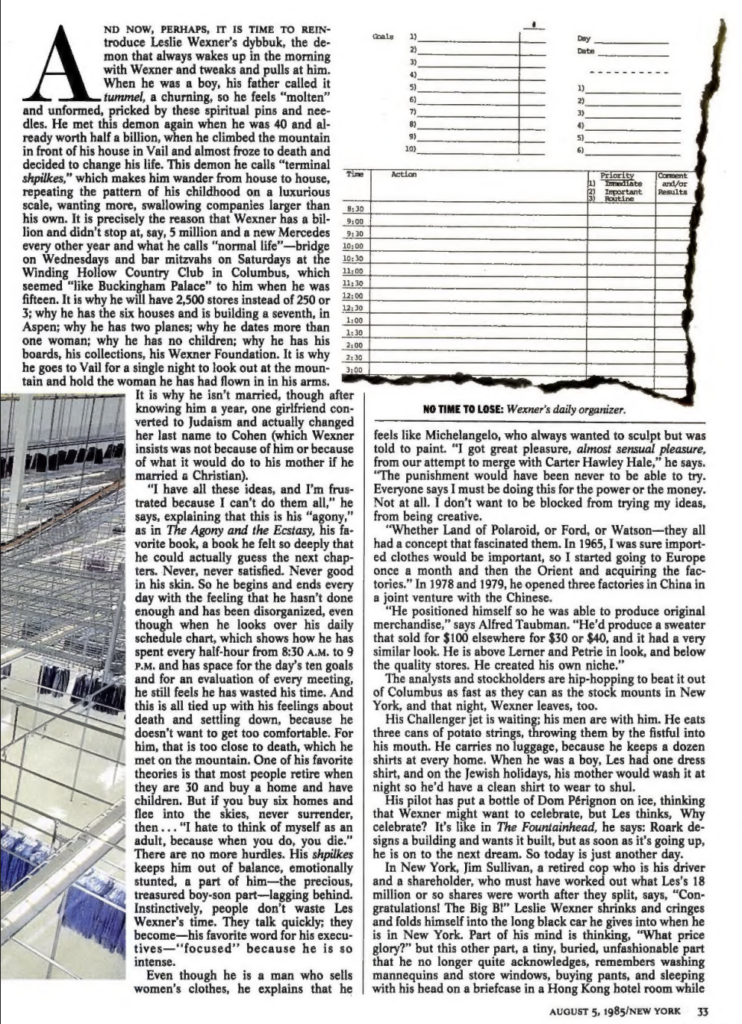
Epstein co-conspirator, Les Wexner, admitted to being demon-possessed in a New York Magazine article from August 5, 1985…
Scroll to “page 33” (of course) of the article to read the following portion of text…
“And now, perhaps, it is time to reintroduce Leslie Wexner’s dybbuk, the demon that always wakes up in the morning with Wexner and tweaks and pulls at him. When he was a boy, his father called it “tummel”, a churning, so he feels “molten” and unformed, pricked by these spiritual pins and needies. He met this demon again when he was 40 and already worth half a billion, when he climbed the mountain in front of his house in Vail and almost froze to death and decided to change his life. This demon he calls “terminal shpilkes,” which makes him wander from house to house, repeating the pattern of his childhood on a luxurious scale, wanting more, swallowing companies larger than his own. It is precisely the reason that Wexner has a billion and didn’t stop at, say, 5 million and a new Mercedes every other year and what he calls “normal life”—bridge on Wednesdays and bar mitzvahs on Saturdays at the Winding Hollow Country Club in Columbus, which seemed “like Buckingham Palace” to him when he was fifteen. It is why he will have 2,500 stores instead of 250 or 3; why he has the six houses and is building a seventh, in Aspen; why he has two planes; why he dates more than one woman; why he has no children; why he has his boards, his collections, his Wexner Foundation. It is why he goes to Vail for a single night to look out at the mountain and hold the woman he has had flown in in his arms. It is why he isn’t married, though after knowing him a year, one girlfriend converted to Judaism and actually changed her last name to Cohen (which Wexner insists was not because of him or because of what it would do to his mother if he married a Christian).
“I have all these ideas, and I’m frus- trated because I can’t do them all,” he says, explaining that this is his “agony,” as in The Agony and the Ecstasy, his favorite book, a book he felt so deeply that he could actually guess the next chapters, Never, never satisfied. Never good in his skin. So he begins and ends every day with the feeling that he hasn’t done enough and has been disorganized, even though when he looks over his daily schedule chart, which shows how he has spent every half-hour from 8:30 a.m. to 9 p.m. and has space for the day’s ten goals and for an evaluation of every meeting, he still feels he has wasted his time. And this is all tied up with his feelings about death and settling down, because he doesn’t want to get too comfortable. For him, that is too close to death, which he met on the mountain. One of his favorite theories is that most people retire when they are 30 and buy a home and have children. But if you buy six homes and flee into the skies, never surrender, then… “I hate to think of myself as an adult, because when you do, you die.” There are no more hurdles. His shpilkes keeps him out of balance, emotionally stunted, a part of him—the precious, treasured boy-son part—lagging behind. Instinctively, people don’t waste Les Wexner’s time. They talk quickly; they become—his favorite word for his executives —‘‘focused” because he is so intense.”